Introduction
Charging your phone is one of the most important parts of traveling in Japan.
You will use your phone for maps, train routes, translation, hotel bookings, weather, photos, tickets, payments, and emergency information. If your battery dies during the day, even a simple trip can become stressful.
Japan uses a plug shape that may already work for some travelers, especially visitors from North America. But travelers from Europe, the UK, Australia, and many other countries usually need a plug adapter.
This guide explains Japan’s power plugs, voltage, adapters, USB charging, power banks, and what first-time visitors should prepare before arriving.
Quick Answer
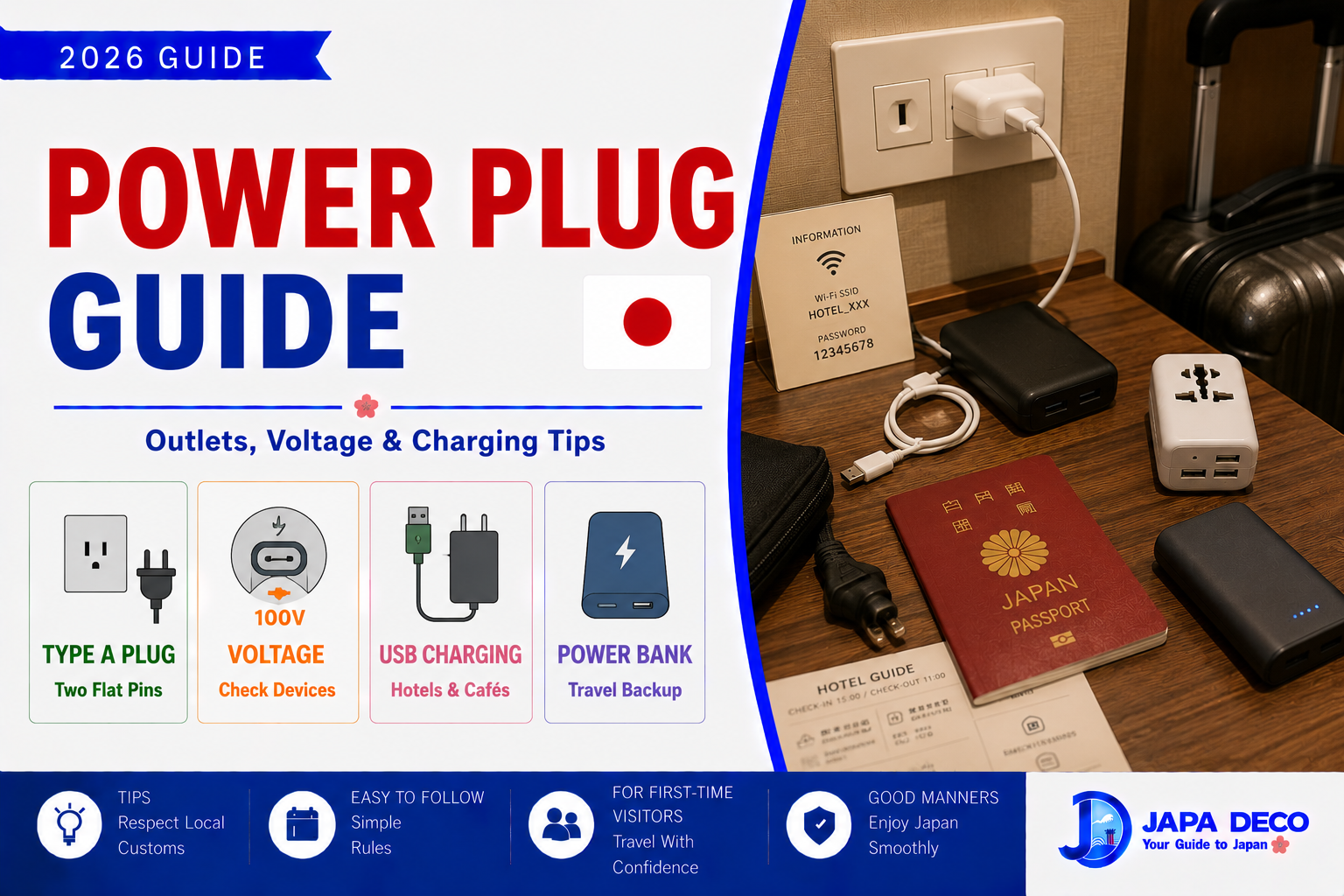
Japan mainly uses Type A plugs.
Type A plugs have two flat pins.
If your charger has two flat pins, it may fit Japanese outlets.
If your plug is from Europe, the UK, Australia, or many other regions, you will need a plug adapter.
Japan’s voltage is commonly 100V, so check your device label before using it.
Most modern phone chargers, laptop chargers, and camera chargers support worldwide voltage, but not every device does.
Always check before plugging in hair dryers, straighteners, electric shavers, or other heat-producing items.
Japan Plug Type
The most common plug type in Japan is Type A.
This plug has two flat parallel pins.
Some outlets may also accept Type B plugs with a grounding pin, but many Japanese outlets do not have a ground hole.
For travel, a simple Type A adapter is usually enough for phones, cameras, and laptops.
If your plug is already Type A, you may not need an adapter.
If your plug is round, angled, or has three large pins, you probably need one.
【Image①】
Voltage in Japan
Japan commonly uses 100V electricity.
This is lower than many countries.
Before using any device, check the small text on the charger or power brick.
Look for something like:
Input: 100-240V
If your charger says 100-240V, it usually works in Japan with only a plug adapter.
Most modern phone chargers and laptop chargers support this range.
But some devices only support one voltage.
Be especially careful with:
- Hair dryers
- Hair straighteners
- Curling irons
- Electric kettles
- Electric toothbrush chargers
- Shavers
- Older electronics
Heat-producing devices are the most risky.
Adapter vs Converter
A plug adapter and a voltage converter are not the same thing.
A plug adapter only changes the shape of the plug.
A voltage converter changes the electrical voltage.
Most travelers only need a plug adapter for phones and laptops because modern chargers often support 100-240V.
But if your device does not support Japan’s voltage, a plug adapter alone is not enough.
Check the device label before using it.
If you are unsure, do not plug it in.
For hair tools, it is often easier to bring a dual-voltage travel version or use the hotel’s equipment.
What to Bring
For most travelers, bring:
- Type A plug adapter
- USB wall charger
- USB-C cable
- Lightning cable if needed
- Power bank
- Multi-port charger
- Laptop charger
- Camera battery charger
- Short backup cable
A multi-port charger is very useful because hotel rooms may have limited outlets.
If you travel with family, bring more than one adapter.
One adapter is not enough if several people need to charge phones, cameras, tablets, and power banks at night.
【Image②】
Hotel Room Outlets
Most Japanese hotels have outlets near the desk, bed, or entrance.
Modern hotels may also have USB ports.
However, older hotels may have fewer outlets than expected.
Capsule hotels may have only one outlet inside the capsule.
Ryokan may have outlets, but not always in convenient places near the futon.
Before sleeping, charge everything you need for the next day:
- Phone
- Power bank
- Pocket WiFi
- Camera
- Smartwatch
- Earbuds
If you use your phone heavily for maps and photos, a full charge in the morning is essential.
USB Charging
Many newer hotels, cafes, airport lounges, trains, and buses may offer USB charging.
But do not rely on public USB charging as your main plan.
Bring your own charger and cable.
USB-C is becoming more common, but older USB-A ports still exist.
If your cable is only USB-C to USB-C, consider bringing a small USB-A backup cable or adapter.
This can help when charging ports are older.
Power Banks
A power bank is one of the most useful items for Japan travel.
You may use your phone all day for:
- Google Maps
- Translation apps
- Train routes
- Photos
- Tickets
- Restaurant searches
- Messages
- Taxi apps
Battery drains quickly during sightseeing.
A power bank gives you backup when you are away from the hotel.
Choose a power bank that is small enough to carry every day.
Also remember to charge the power bank every night.
Pocket WiFi Charging
If you rent pocket WiFi, you must charge it daily.
This is easy to forget.
If the pocket WiFi battery dies, everyone using it may lose internet.
For pocket WiFi users, carry:
- Pocket WiFi device
- Charging cable
- Power bank
- Small pouch
Do not leave the pocket WiFi charging cable behind at a hotel.
If you lose rental equipment or accessories, extra fees may apply.
【Image③】
Trains, Cafes, and Airports
Some Shinkansen seats, airport lounges, cafes, and newer buses may have power outlets or USB ports.
But availability depends on the train, seat, vehicle, and location.
Do not assume every train seat has an outlet.
If charging is important, charge before leaving the hotel or carry a power bank.
Airports usually have charging areas, but they may be crowded.
Cafes may have outlets at some seats, but not all.
Hair Dryers and Hair Tools
Many hotels in Japan provide hair dryers.
If you only need a basic hair dryer, using the hotel one is usually easiest.
Be careful with bringing your own hair dryer, straightener, or curling iron.
These devices may not work properly if they are not compatible with Japan’s voltage.
They may heat weakly, overheat, or become unsafe.
Check whether your hair tool says dual voltage or 100-240V.
If it does not, do not use it with only a plug adapter.
Common Mistakes to Avoid
The biggest mistake is confusing a plug adapter with a voltage converter.
A plug adapter does not change voltage.
Another mistake is bringing only one adapter for several people.
Some travelers also forget to charge their power bank.
Do not assume every hotel has many outlets.
Do not assume every cafe or train has charging access.
And do not use non-compatible hair tools without checking voltage.
Best Recommendation for First-Time Visitors
For most first-time visitors, the best setup is simple:
Bring one or two Type A adapters, a multi-port USB charger, your normal phone cable, and a power bank.
Check your laptop and phone charger labels before travel.
If they say 100-240V, you usually only need a plug adapter.
For hair tools, use hotel equipment or bring a dual-voltage travel model.
This setup covers almost every normal travel situation.
Conclusion
Japan’s power plug system is easy to manage if you prepare before your trip.
Japan mainly uses Type A plugs with two flat pins, and the voltage is commonly 100V. Many modern phone, laptop, and camera chargers support worldwide voltage, but you should always check the label.
Most travelers need a plug adapter, not a voltage converter.
Bring a multi-port charger, backup cables, and a power bank. If you use pocket WiFi, charge it every night.
With the right charging setup, your phone stays ready for maps, trains, translation, photos, and everything else you need during your Japan trip.
コメント