
How to Use Chopsticks: Grip, Practice and Etiquette
Learn a stable chopstick grip, simple practice drills, techniques for rice, noodles and slippery foods, and the table manners travelers need in Japan.
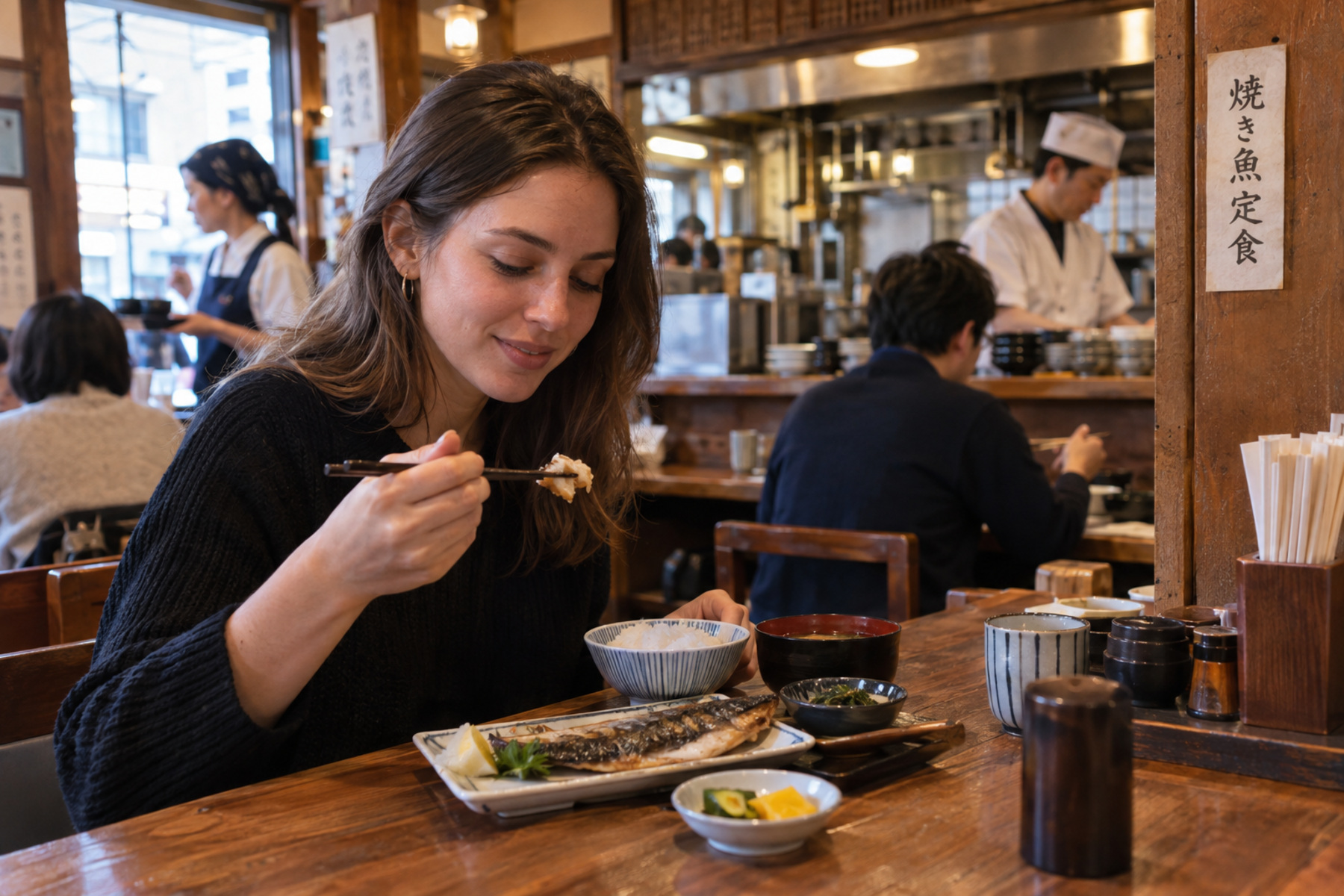
Rest the lower chopstick against the base of your thumb and support it with your ring finger; keep it still. Hold the upper chopstick like a pencil with your thumb, index finger and middle finger. Open and close only the upper stick, keeping the tips aligned. At the table, never stand chopsticks upright in rice or pass food directly from chopsticks to chopsticks.
What You’ll Learn
- How to build a stable lower chopstick and a movable upper chopstick
- Practice drills that improve control without squeezing harder
- Techniques for rice, noodles, tofu, fish and small foods
- How to use serving chopsticks with shared dishes
- The chopstick gestures to avoid at Japanese tables
Set Up Your Hand Before Picking Up Food
Sit close enough to the table that your forearm can move without lifting your shoulder. Hold the chopsticks around the upper third rather than near the food ends. A grip that is too low gives little reach, while a grip at the extreme back can feel unstable for a beginner.
Align both tips before you start. The chopsticks should cross neither in your hand nor at the tips. If the tips meet unevenly, slide one stick slightly forward or backward before tightening your grip.
- Keep your wrist relaxed and roughly in line with your forearm.
- Hold the chopsticks around the upper third.
- Match the tips before attempting to pick up food.
- Use light pressure; control comes from alignment, not force.
Anchor the Lower Chopstick
Place the lower chopstick in the valley between your thumb and index finger. Let its front section rest on the side of your ring finger. This stick forms the stable base and should remain nearly motionless while you eat.
Do not pinch the lower stick with every finger. If it slides, adjust the contact point on your ring finger or move your grip slightly higher. A secure three-point rest is more effective than squeezing.
- Back contact: the base of the thumb.
- Front support: the side of the ring finger.
- Movement: keep the lower chopstick still.
Move Only the Upper Chopstick
Hold the upper chopstick as you would hold a pencil, supported by the thumb and controlled by the index and middle fingers. Bend and straighten those two fingers to move the upper tip toward and away from the fixed lower tip.
Practice opening a small gap, closing the tips together and opening again. The shafts do not need to remain perfectly parallel at every moment, but the tips should meet cleanly. If both sticks swing, pause and rebuild the lower anchor.
- Thumb: stabilizes both sticks.
- Index and middle fingers: move the upper stick.
- Ring finger: supports the lower stick.
- Goal: the two tips meet without crossing.
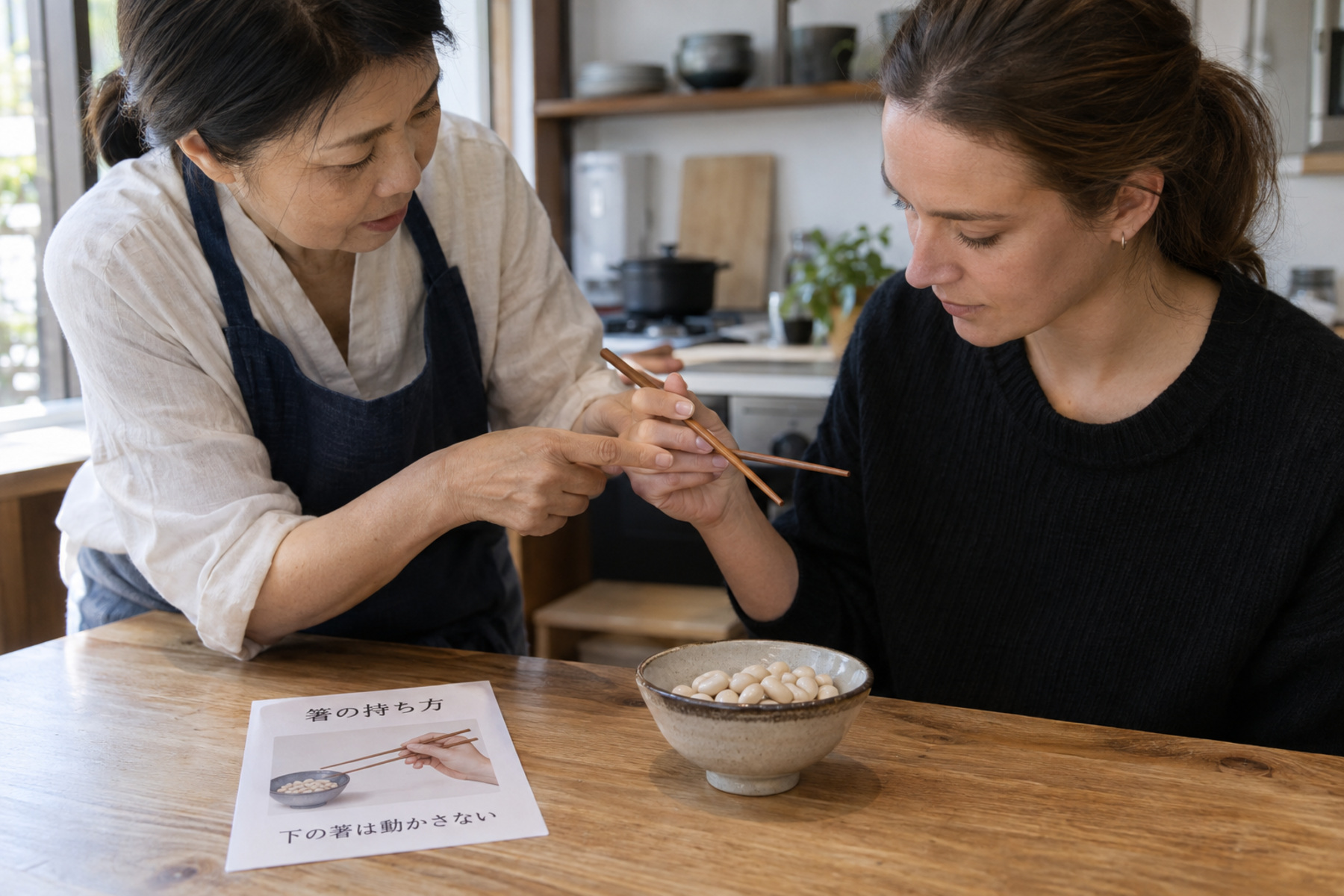
Practice Control in Three Steps
Begin with objects that are dry, firm and large enough to grip. Move folded pieces of paper, corks or large beans between two bowls. Next, try smaller beans or smooth grapes. Finish with softer food such as tofu only after you can close the tips gently.
Short practice is more useful than a long session with a tense hand. If your fingers hurt, loosen the grip and reset. Speed follows accurate repetition; it does not come from pressing harder.
- First: large, dry pieces.
- Next: small or smooth pieces.
- Last: soft food that requires gentle pressure.
- Reset whenever the tips cross or your hand becomes tense.
Match the Technique to the Food
For a firm bite, close the tips around its center of mass and lift smoothly. For slippery food, use a wider contact area by lowering the angle of the chopsticks. For soft tofu, approach from opposite sides and use only enough pressure to support it.
Fish often separates along natural flakes. Hold the piece steady, then use the upper chopstick to separate a bite rather than sawing through it. For small bones, work slowly and place removed bones on the designated plate instead of hiding them in rice.
- Firm food: grip near the center.
- Slippery food: reduce the angle and increase tip contact.
- Soft food: lift with minimal pressure.
- Fish: separate along the flakes and check for bones.
Handle Rice, Noodles and Sushi Naturally
For Japanese short-grain rice, gather a small bite and lift the rice bowl closer to your mouth when appropriate. Do not shovel food or hold the bowl against your lips. Fried rice and loose grains may be easier with the spoon provided by the restaurant.
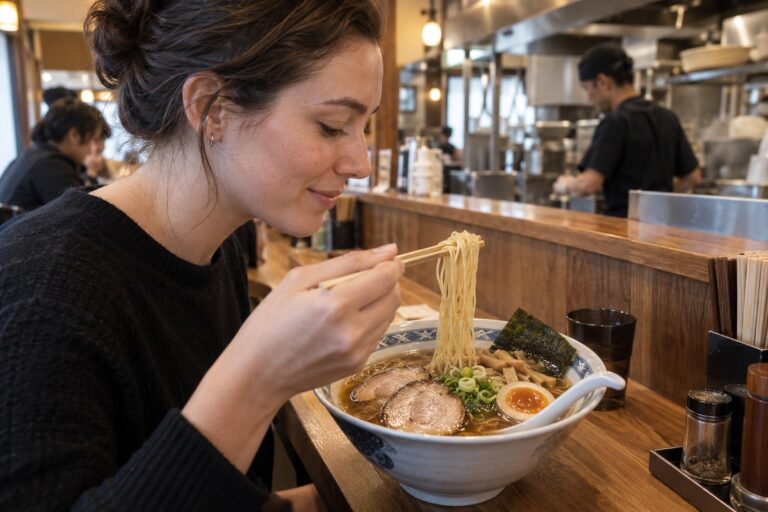
For noodles, lift a manageable bundle, pause over the bowl so excess broth can fall back, and guide the noodles to your mouth. Slurping noodles is common in casual settings but not compulsory. Sushi may be eaten with chopsticks or, in many contexts, with clean fingers; follow the atmosphere of the restaurant and handle each piece gently.
- Rice: take a small bite and bring the bowl closer when suitable.
- Noodles: lift a short bundle rather than the whole serving.
- Sushi: avoid squeezing the rice until it breaks.
- Use the spoon or utensil supplied when it works better.
Use Serving Chopsticks for Shared Dishes
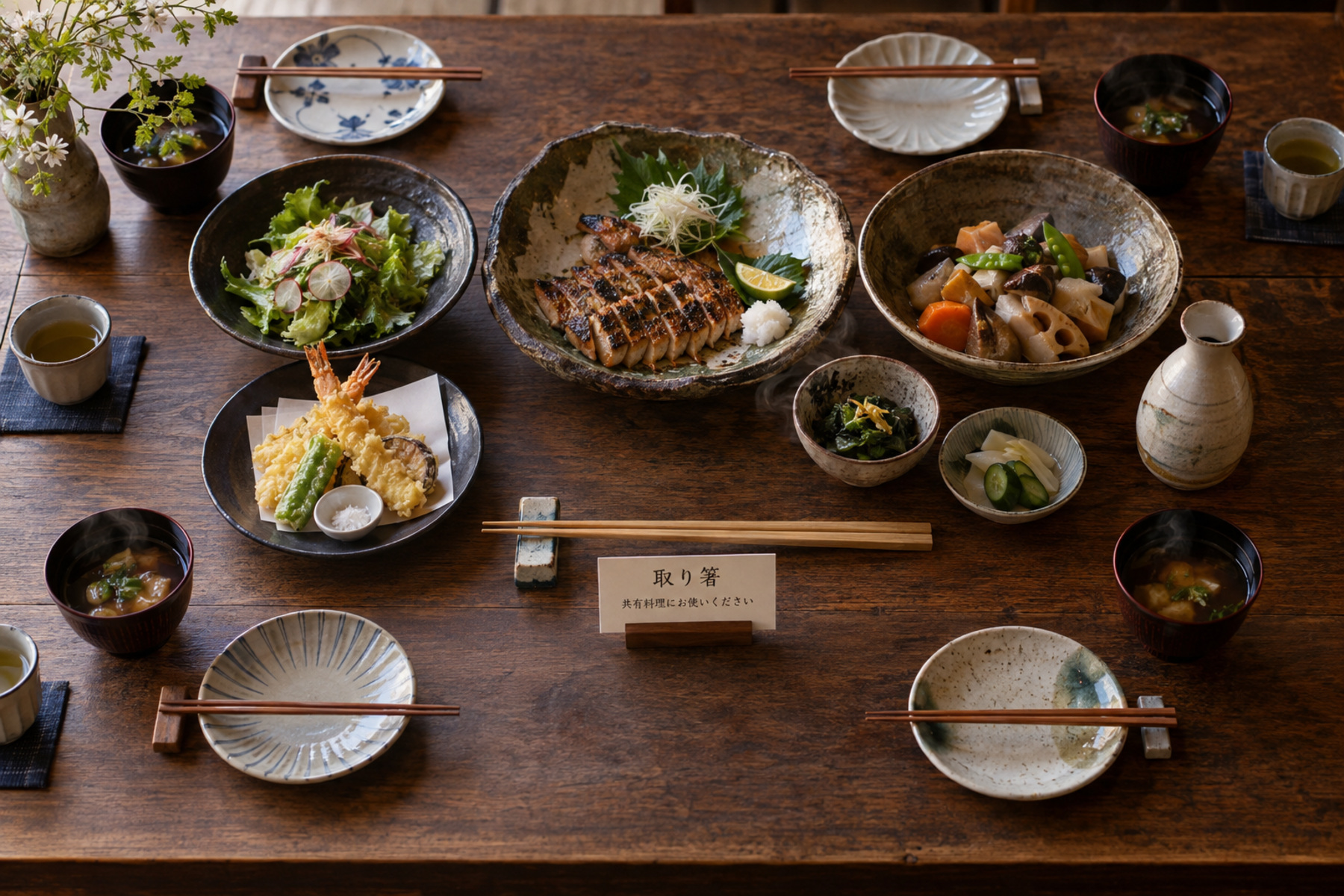
When a shared plate comes with serving chopsticks, called toribashi, use them to move food to your own plate. Return them to the shared plate or their rest with the handles facing diners and the food-contact ends kept over the serving area.
Do not assume that reversing your personal chopsticks is the preferred solution; the handle ends have been touched by your hand and may still create hygiene concerns. If no serving utensil is present, ask staff or follow the host’s direction.
- Look for separate serving chopsticks or a serving spoon.
- Move food to your own plate before eating it.
- Ask for a utensil instead of improvising when hygiene is unclear.
Avoid the Two Most Serious Gestures
Never stand chopsticks upright in a bowl of rice. This resembles a ritual offering associated with funerals. Also never pass food directly from your chopsticks to another person’s chopsticks, because that movement recalls a funeral custom involving cremated remains.
If you want to share food, place it on the other person’s plate with serving chopsticks. If you need to put your chopsticks down, use the chopstick rest or place them neatly across the holder provided.
- Do not place chopsticks vertically in rice.
- Do not transfer food from chopsticks to chopsticks.
- Use a plate and serving utensil when sharing.
Skip Pointing, Spearing and Searching
Do not point at people or objects with chopsticks, wave them while talking, drum on bowls or stab food as though using a fork. Avoid hovering over several dishes while deciding and do not dig through a shared plate searching for a preferred piece.
Disposable wooden chopsticks may be gently separated over your lap or close to the table. Do not rub them together dramatically; if the pair has a dangerous splinter, ask for a replacement. Keep gestures small and return the chopsticks to a rest whenever you pause.
- No pointing, waving or drumming.
- No stabbing food with one or both sticks.
- Choose before reaching into a shared dish.
- Ask for replacement disposable chopsticks if they splinter.
Finish the Meal Neatly
During a pause, place chopsticks together on the chopstick rest with the tips pointing left when the table setting supports that orientation. Do not leave them balanced across a bowl where they can fall or obstruct serving.
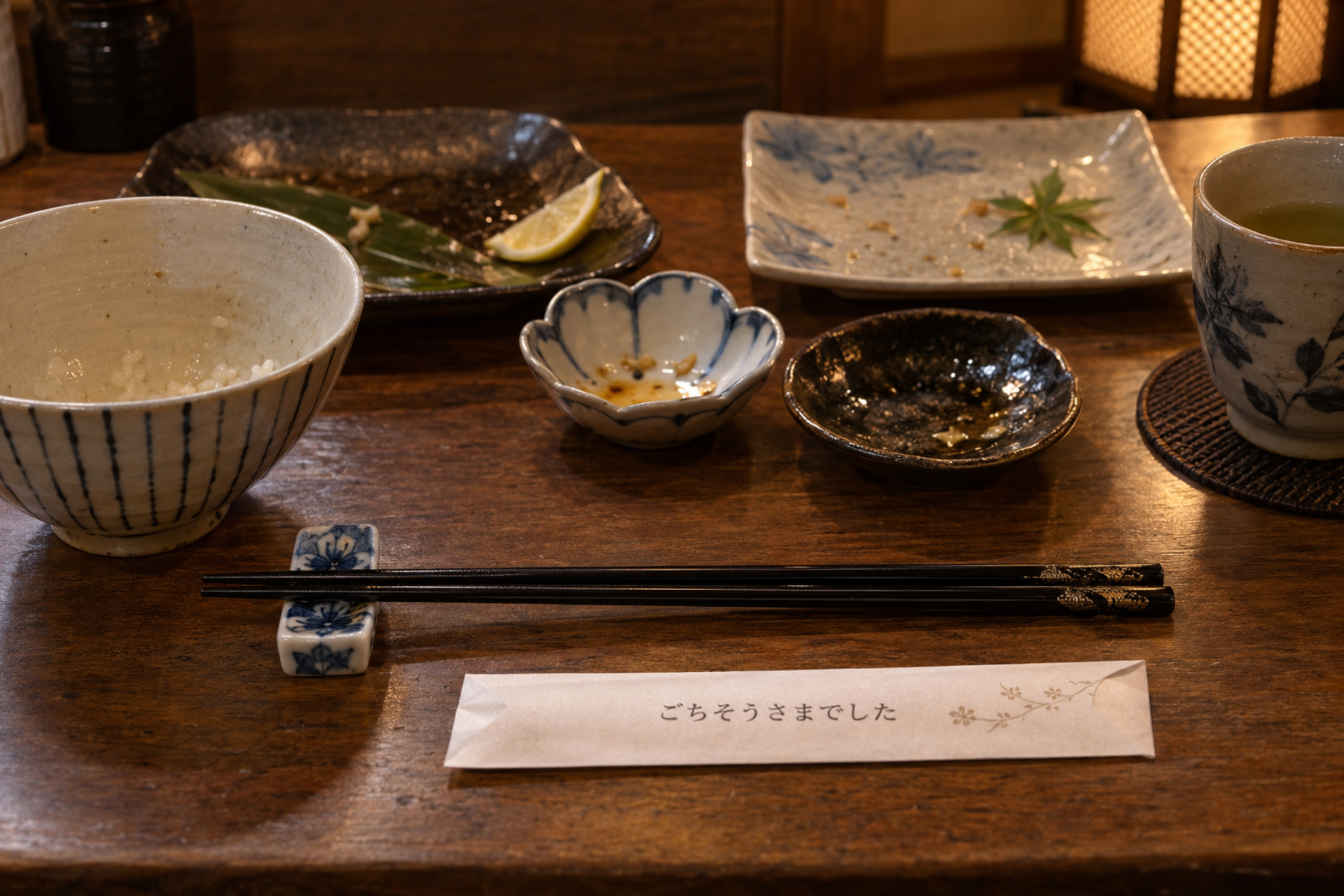
At the end of the meal, return reusable chopsticks to the rest. With disposable chopsticks, some venues expect them to be placed back partly inside the paper sleeve, while others simply provide a tray or rest. Follow the table setup rather than inventing a signal.
- Keep the pair together and aligned.
- Use the chopstick rest during pauses.
- Follow the restaurant’s tray, sleeve or disposal setup.
- A fork is acceptable when needed; ask politely rather than struggling.
FAQ
Which chopstick should move?
The upper chopstick moves with the index and middle fingers. The lower chopstick stays anchored against the base of the thumb and ring finger.
Why do my chopsticks cross?
The lower stick is probably moving or the tips are uneven. Reset the lower anchor, align the tips and practice a smaller opening motion.
Is it rude to ask for a fork in Japan?
No. Use the utensil that lets you eat safely and neatly. Ask staff politely if a fork or spoon is not already provided.
Can I eat sushi with my hands?
In many settings, nigiri sushi may be eaten with clean fingers or chopsticks. Follow the restaurant atmosphere and handle the sushi gently.
Is slurping noodles required?
No. It is common and accepted in casual noodle settings, but you do not have to slurp. Lift a manageable bundle and eat without splashing.
Can I stick chopsticks upright in rice for a moment?
No. The gesture is associated with funeral ritual. Place the chopsticks together on a rest instead.
Can I pass food directly to another person’s chopsticks?
No. Place the food on their plate using serving chopsticks because chopstick-to-chopstick transfer recalls a funeral custom.
Should I reverse my chopsticks to serve shared food?
Use the separate serving chopsticks or spoon when supplied. If none is present, ask the host or staff rather than assuming the handle ends are hygienic.
Related Japan Travel Guides
Official References
Final Thoughts
Good chopstick technique is a stable lower stick, a lightly controlled upper stick and aligned tips. Practice with easy objects before soft or slippery foods, then keep table gestures calm and deliberate. If control fails during a meal, reset your grip or ask for another utensil—respectful eating matters more than performing perfect technique.