Halal Food in Japan: How to Find and Verify Meals
Learn how to find and verify halal food in Japan, check certification and kitchen practices, identify hidden ingredients, and prepare backup meals for travel days.
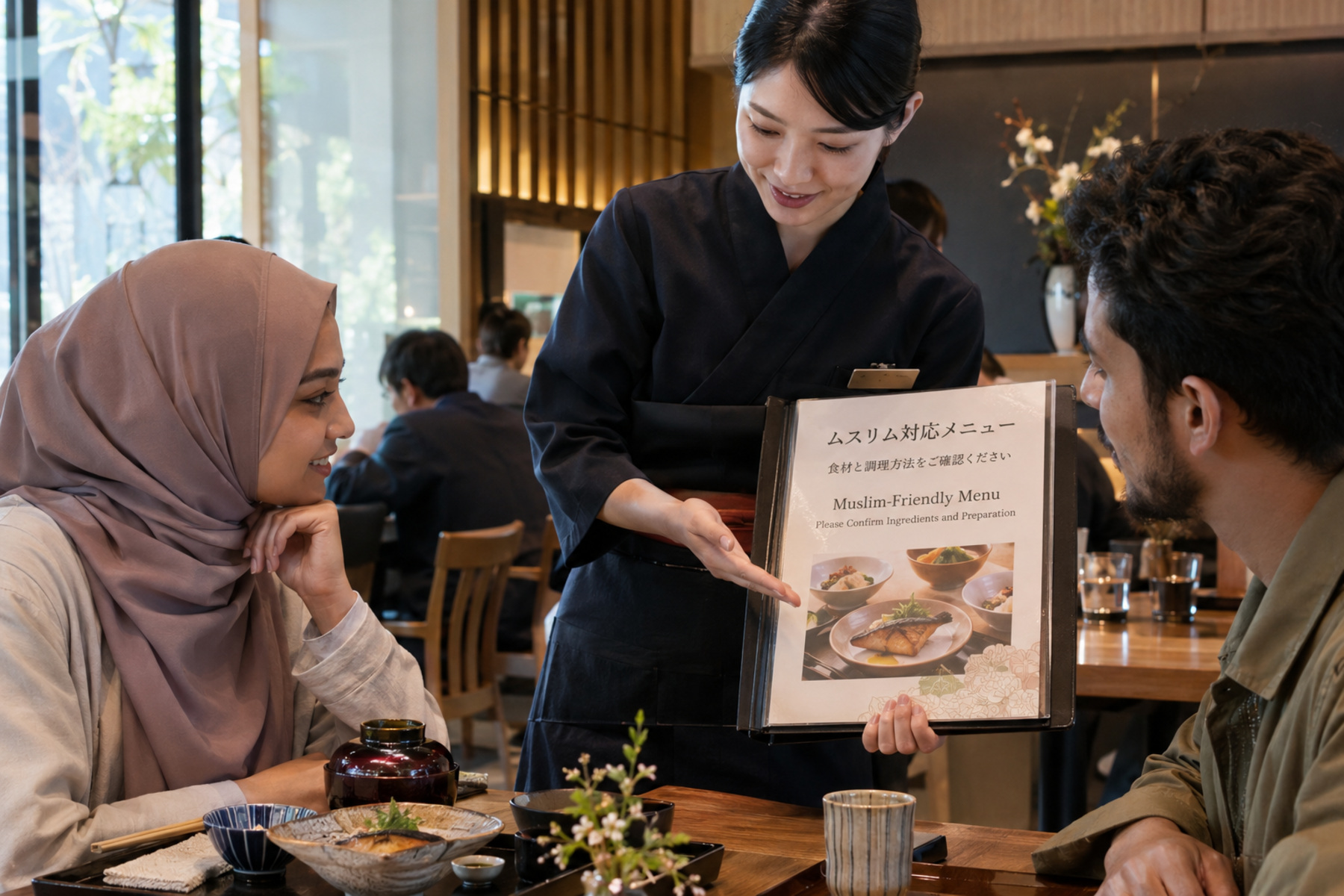
Halal food is increasingly available in Japan, especially in major cities, but labels such as Muslim-friendly, no pork and halal ingredients do not always mean the same thing as full halal certification. Check the restaurant’s current policy, certifying body, meat source, alcohol-based seasonings and shared cookware before visiting. Carry a written requirement card and keep a simple backup meal for routes with limited choices.
What You’ll Learn
- How halal-certified, Muslim-friendly and no-pork claims differ
- What to confirm with a restaurant before traveling there
- Which Japanese seasonings and processed ingredients need checking
- How to plan hotels, convenience-store stops and regional travel
- How to build a backup meal without relying on assumptions
Understand What Each Food Claim Means
A restaurant described as halal-certified should be able to identify its certifying organization and the scope of the certification. Japan does not have one central national halal accreditation agency, so standards and coverage can differ. A certificate may apply to an entire kitchen, a production line, selected ingredients or specific menu items.
Muslim-friendly is a broader description and may mean the venue offers no-pork dishes, halal meat, ingredient information or prayer support while still serving alcohol or using a shared kitchen. No pork means only that pork is excluded from the stated item; it does not answer questions about meat slaughter, alcohol, gelatin, stock or shared equipment.
- Halal-certified: verify the certifying body, validity and exact scope.
- Muslim-friendly: read the venue’s specific practices.
- No pork: does not confirm every ingredient or kitchen process.
- Halal ingredients: may not mean a dedicated halal-only kitchen.
Search by Policy, Not by a Single Label
Begin with official tourism resources and Muslim-focused restaurant guides, then open the restaurant’s own current website or social account. Look for a full address, opening hours, reservation rules, menu scope, certification details and a statement about alcohol or shared cooking equipment.
Map listings and old blog posts are useful leads, not final proof. Restaurants change menus, suppliers and operating hours. Contact the venue directly before making a long trip, especially when only selected dishes are halal or advance reservation is required.
- Confirm the exact branch; policies can differ within a group.
- Check whether halal dishes require advance booking.
- Ask whether the kitchen still follows the published policy.
- Save the restaurant name, address and confirmation message offline.
Ask Five Questions Before Ordering
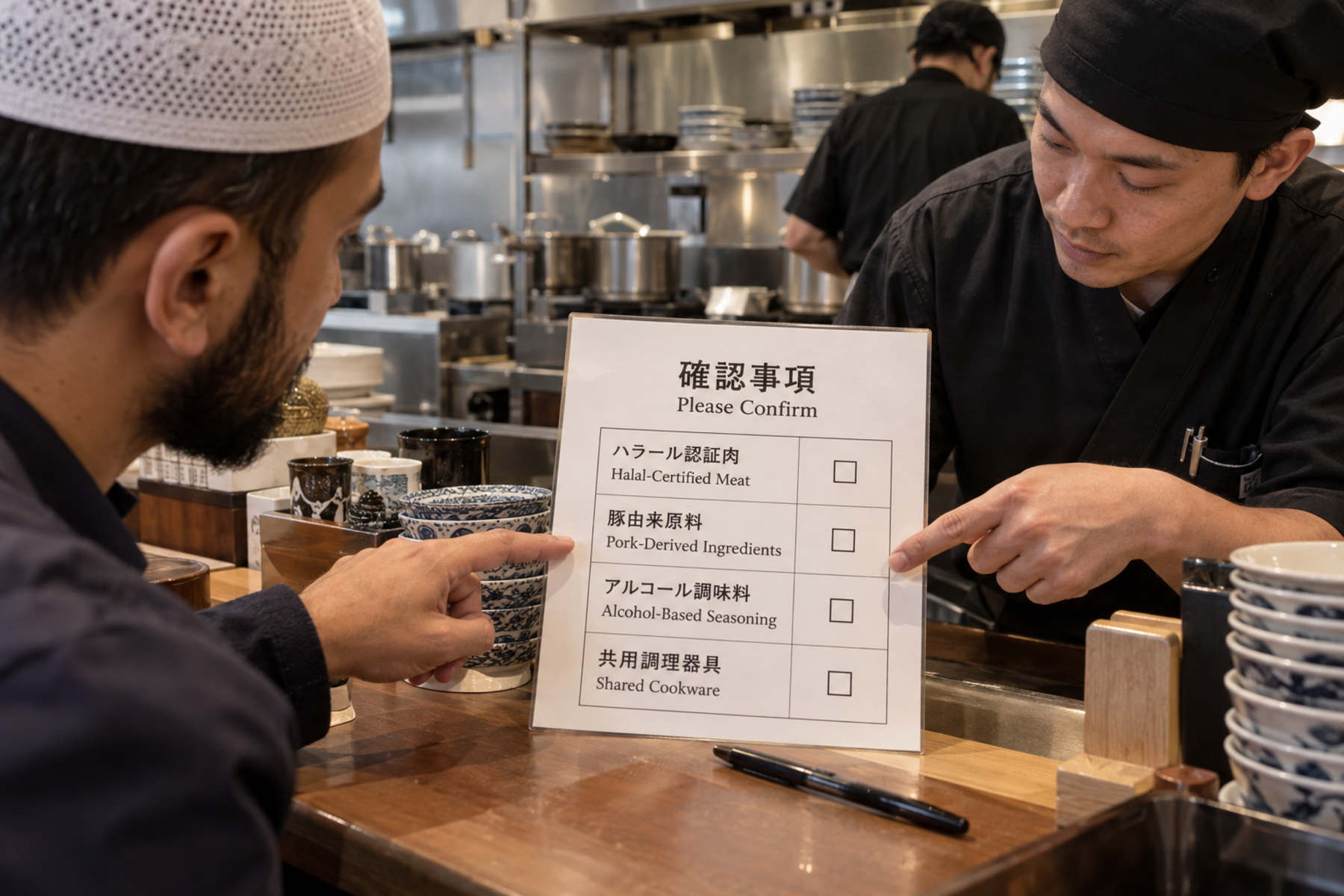
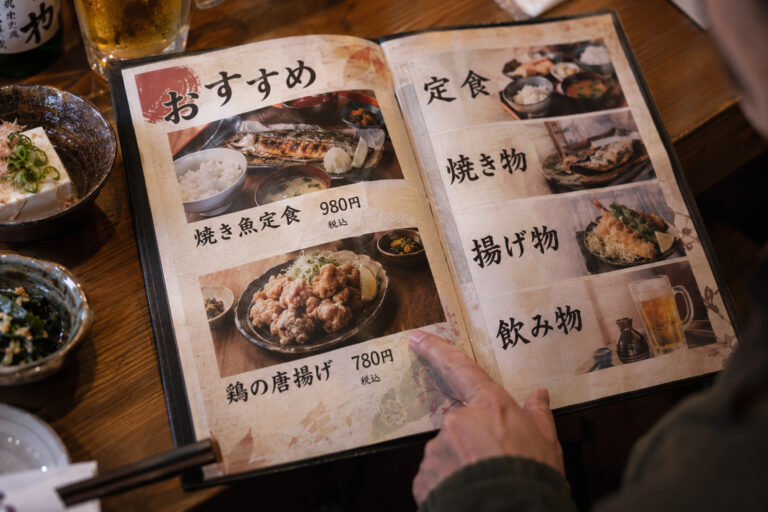
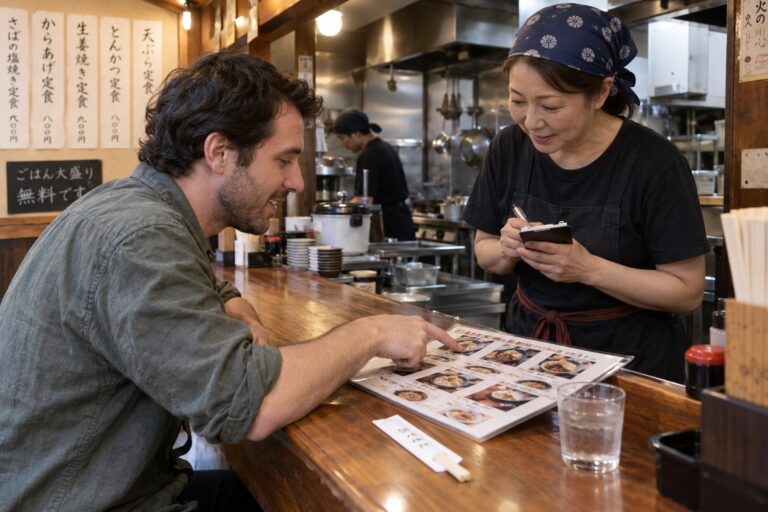
Explain your own requirements rather than expecting staff to interpret a broad label. Ask whether the specific dish uses halal-certified meat, pork or pork-derived ingredients, alcohol-based seasoning, and shared fryers, grills, knives or cookware. Also confirm whether alcohol is served at the venue if that affects your decision.
A written card reduces language mistakes. Useful questions include: Kono ryori ni butaniku wa haitte imasu ka—does this dish contain pork? Arukoru o tsukatte imasu ka—do you use alcohol? Chori kigu wa kyoyu desu ka—is the cooking equipment shared? If the answer is uncertain, choose another item or venue.
- Is the meat halal-certified?
- Does the dish contain pork, lard or pork-derived gelatin?
- Are mirin, cooking sake or other alcohol-based ingredients used?
- Are fryers, grills, knives or cookware shared?
- Does the restaurant serve alcohol, and is that acceptable for you?
Check Seasonings and Hidden Ingredients
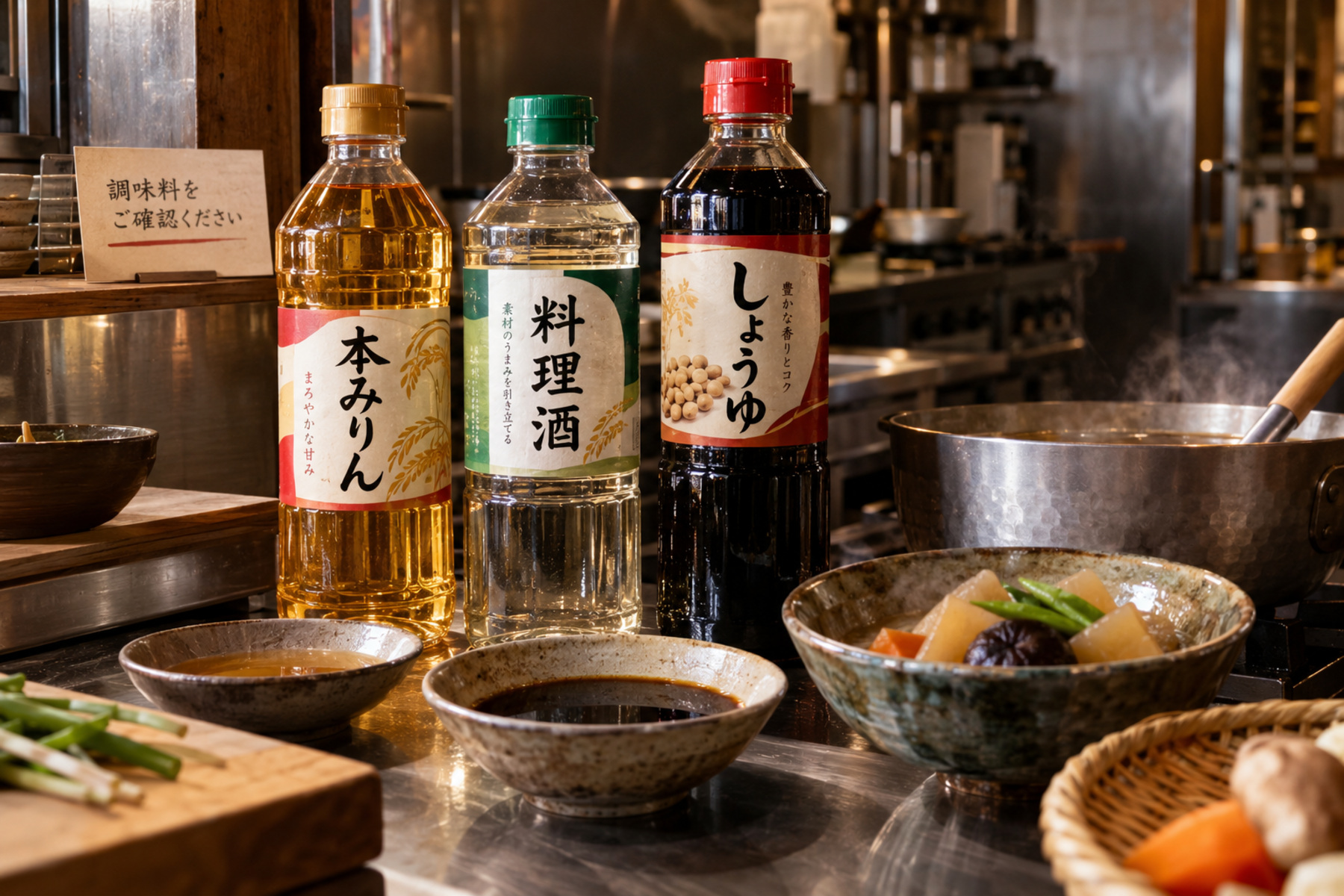
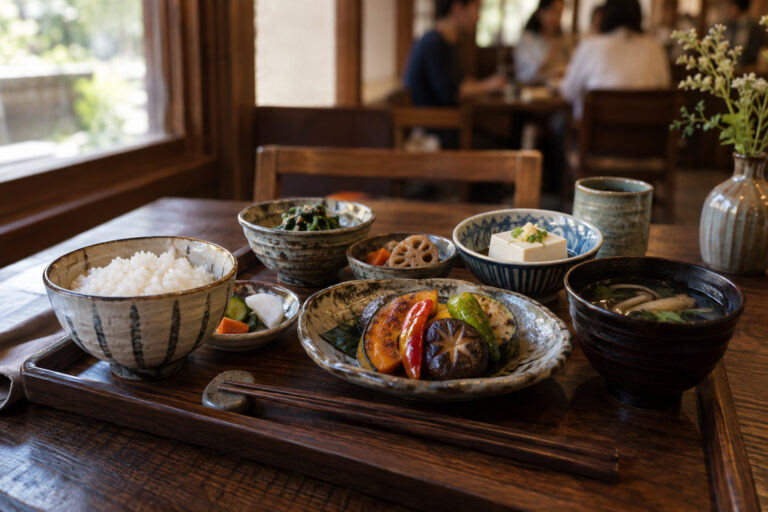
A dish that looks like plain rice, seafood or vegetables can contain ingredients that are not visible. Mirin and cooking sake are common in sauces, marinades, simmered dishes and soup bases. Soy sauce, miso and vinegar products vary, so the product or restaurant preparation needs to be checked rather than judged by the ingredient name alone.
Pork stock, lard, gelatin, emulsifiers and meat extracts can appear in ramen broth, curry roux, gyoza, bread, desserts, sweets and packaged foods. Bonito or other fish stock may matter for travelers who combine halal requirements with vegetarian preferences.
- Ask about sauce, broth, marinade and cooking oil.
- Check desserts and sweets for gelatin or alcohol flavoring.
- Do not treat seafood or vegetable dishes as automatically halal.
- Confirm processed ingredients when the restaurant can identify them.
Decide How You Feel About Shared Kitchens
Some venues use halal ingredients but prepare them in a kitchen that also handles pork or non-halal meat. They may share a fryer, grill, counter, knife, cutting board or storage area. Other venues use separate utensils or a dedicated preparation zone.
There is no single decision that fits every Muslim traveler. Ask the restaurant to describe its actual process, then apply the standard you follow. A clear disclosure is more useful than an undefined friendly label.
- Dedicated kitchen or preparation area
- Separate cookware, knives and boards
- Shared fryer or grill
- Separate storage and serving utensils
Use Convenience Stores Carefully
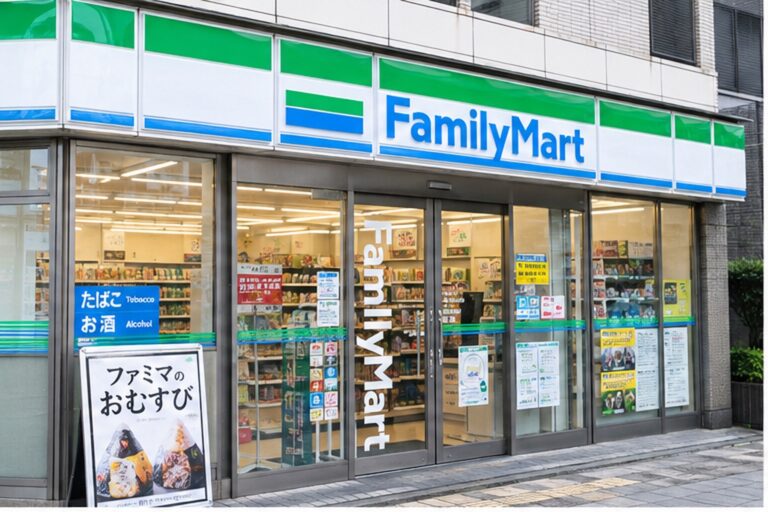
Japanese convenience stores are useful for drinks, fruit, plain packaged foods and emergency supplies, but most ready-to-eat products are not designed as halal guarantees. Ingredient labels are generally in Japanese, recipes can change and a familiar-looking rice ball, bread or dessert may contain meat extract, gelatin, alcohol or an unsuitable seasoning.
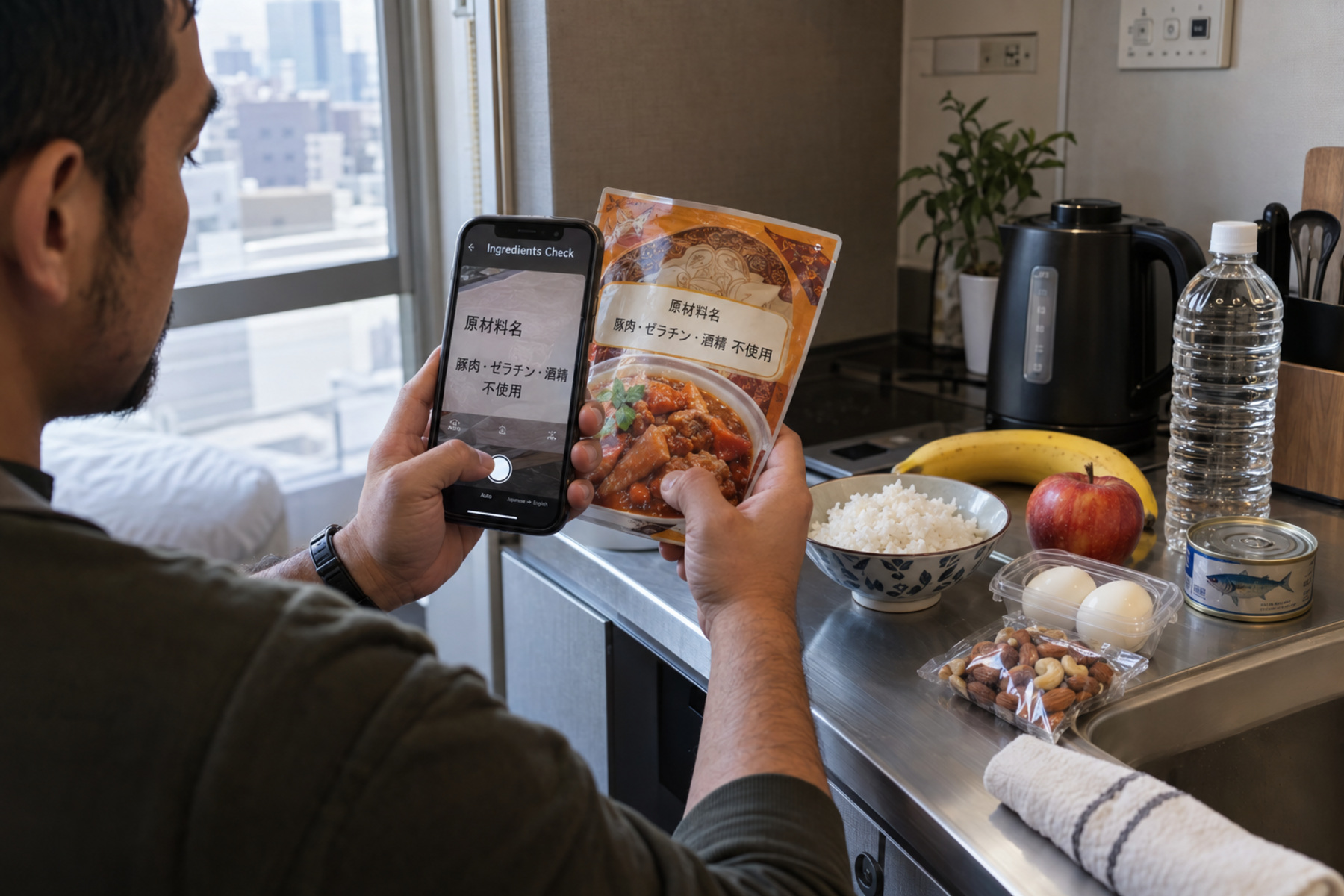
Use camera translation to understand the label, but do not rely on it for a high-stakes dietary decision. Look for 原材料名, meaning ingredients, and アレルギー, meaning allergy information, while remembering that an allergen panel is not a halal certification. Choose clearly identified certified products or simple sealed foods that meet your own requirements.
- 原材料名: ingredients
- 豚肉: pork; ゼラチン: gelatin; 酒精: alcohol
- A product without pork can still have other concerns.
- Recheck the actual package each time because formulations change.
Plan Hotels and Breakfast Before Booking
A hotel described as Muslim-friendly may offer a halal menu, prayer mat, qibla information or nearby restaurant guidance. Ask whether its halal food is certified, prepared in a separate kitchen or available only with advance notice. Breakfast buffets often use shared serving tools and cooking surfaces.
A room with a kitchenette can provide more control, but confirm the appliances and utensils supplied. If shared cookware does not meet your needs, bring or buy a small set of suitable utensils and follow the property’s cooking rules.
- Ask which meals and menu items are covered.
- Confirm the reservation deadline for special meals.
- Check buffet utensils and shared cooking surfaces.
- Verify kitchenette equipment before relying on self-catering.
Prepare for Regional Trips and Late Arrivals
Major cities and international airports usually provide more Muslim-friendly choices than small towns, highway stops or late-night neighborhoods. Build the food plan into the route instead of searching only when hungry. Mark a primary restaurant, a second option and a shop for backup supplies near each overnight stop.
Check last-order time as well as closing time. On long rail or bus journeys, buy a verified meal before boarding because station food and onboard sales may not meet your needs. Save essential questions in Japanese on your phone for places with limited English support.
- Identify two meal options near each base.
- Check last-order time and reservation requirements.
- Buy a verified meal before a long journey.
- Carry shelf-stable backup food permitted by your route and accommodation.
Build a Simple Backup Meal
A backup meal should be easy to verify, portable and sufficient to prevent a rushed decision. Depending on your needs and the available labels, options may include whole fruit, plain rice, sealed halal-certified food, nuts, yogurt, boiled eggs or canned fish. Check every package rather than assuming an entire product category is suitable.
Keep food safety and storage in mind. Refrigerated products need reliable cooling, and accommodation rules may restrict cooking. The goal is not to replace local dining, but to give yourself enough time to find a meal that meets your standard.
- Choose foods with ingredients you can verify.
- Carry enough for transport delays or a missed reservation.
- Observe refrigeration, allergy and accommodation rules.
- Replace used supplies before the next regional leg.
Follow a Repeatable Meal Check
Use the same order every time: confirm the exact branch, read the venue’s halal statement, check the certifying body or specific accommodations, ask about the selected dish and kitchen equipment, then save the response. At the restaurant, repeat the essential requirement before ordering because the person answering online may not be serving you.
If the description is vague, the certificate cannot be explained or staff cannot confirm a key ingredient, do not argue or ask for a guarantee they cannot give. Thank them and use your backup option. Clear limits make travel safer and reduce stress for both the guest and the restaurant.
- Verify the branch and current policy.
- Confirm the exact dish and ingredients.
- Ask about alcohol and shared equipment.
- Repeat the requirement at the restaurant.
- Use the backup plan when certainty is insufficient.
FAQ
Is halal food easy to find in Japan?
It is increasingly available, especially in major cities and tourist areas, but choices can be limited in smaller towns or late at night. Plan meals in advance and keep a backup option.
Does Muslim-friendly mean halal-certified?
Not necessarily. It may describe selected ingredients or services while the restaurant serves alcohol or uses shared equipment. Read the venue’s specific policy.
Is no-pork food automatically halal?
No. It may still contain non-halal meat, alcohol-based seasoning, gelatin or other unsuitable ingredients, and it may be prepared on shared equipment.
Are seafood and vegetarian dishes automatically halal?
No. Sauces, broth, mirin, cooking sake, gelatin, meat extract or shared cookware may still matter. Confirm the complete preparation.
Can I rely on a halal restaurant app or map listing?
Use it to find candidates, then confirm the exact branch through the restaurant’s current information. Listings and policies can become outdated.
Can a convenience-store ingredient label confirm halal status?
An ingredient label can help identify concerns, but it is not a halal certificate and may not explain every production condition. Prefer clearly certified or fully verifiable products.
Should I reserve halal meals at a hotel?
Yes when the hotel requires it. Ask what the meal claim covers, how it is prepared and the deadline for requesting it before booking.
What should I do if restaurant staff are unsure?
Do not pressure them to guarantee something they cannot verify. Thank them and choose another dish, restaurant or backup meal.
Related Japan Travel Guides
Official References
Final Thoughts
A useful halal plan is specific, current and personal to the standard you follow. Verify the exact branch, the certification or stated accommodations, the selected dish and the kitchen process. Then carry a simple backup so an uncertain answer never forces a rushed decision.