Introduction
Ten days in Japan is one of the best trip lengths for first-time visitors.
It gives you enough time to see Tokyo, Kyoto, Osaka, and one or two day trips without feeling as rushed as a 7-day itinerary. You still cannot see everything, but you can build a strong first Japan route with city life, temples, food, shopping, trains, and a little flexibility.
The key is not to add too many places.
A good 10-day Japan itinerary should feel balanced. You need sightseeing days, travel days, food time, rest time, and backup space for weather or crowds.
This guide gives a practical 10-day Japan itinerary for first-time visitors.
Quick Answer
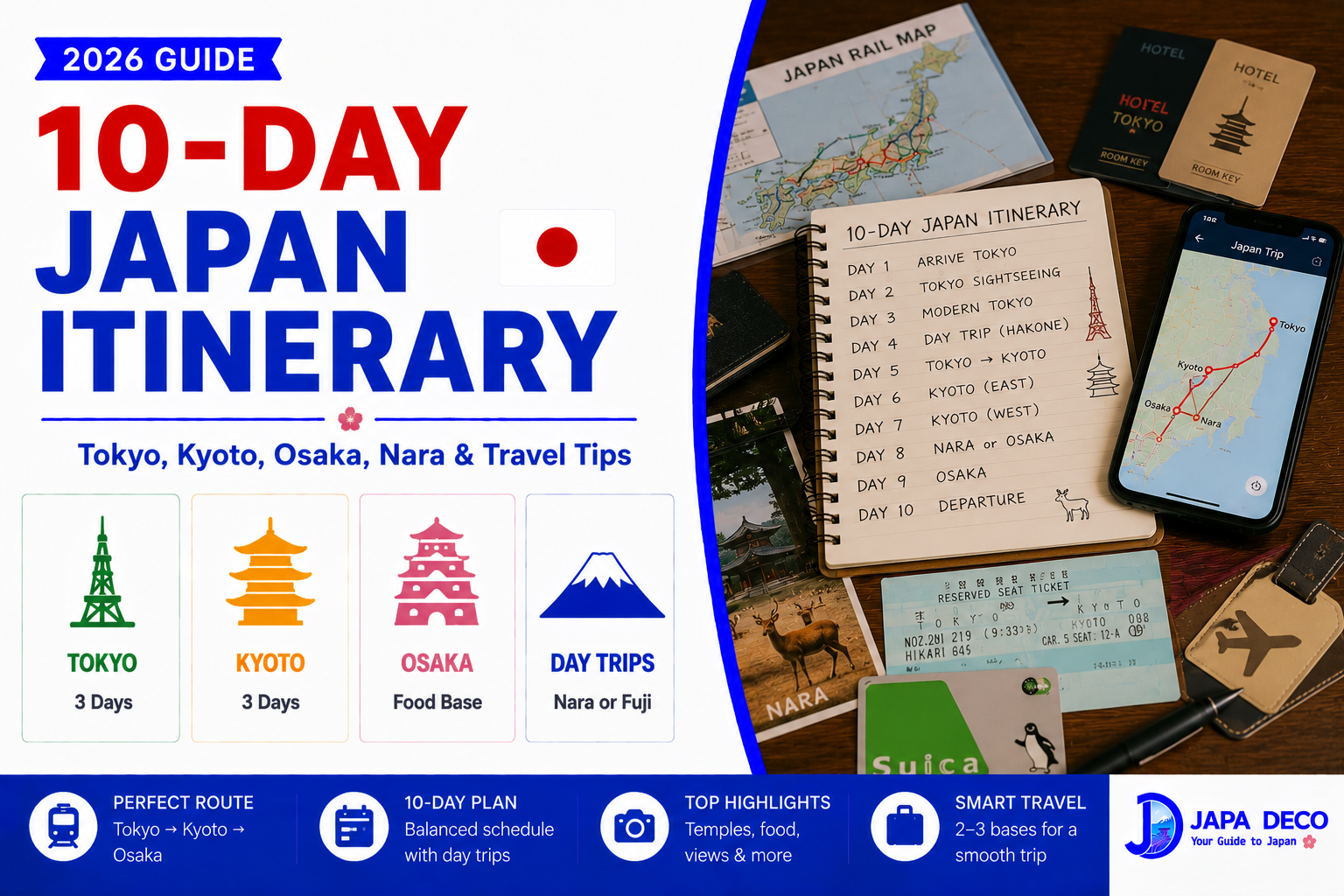
A strong 10-day Japan route is:
- Day 1: Arrive in Tokyo
- Day 2: Tokyo sightseeing
- Day 3: Tokyo neighborhoods
- Day 4: Tokyo day trip or extra Tokyo
- Day 5: Travel to Kyoto
- Day 6: Kyoto sightseeing
- Day 7: Kyoto sightseeing
- Day 8: Nara or Osaka
- Day 9: Osaka
- Day 10: Departure or return to Tokyo
This route works best if you fly into Tokyo and out from Osaka.
If your flights are both from Tokyo, return to Tokyo on Day 9 or choose a route with fewer risks.
Best Route for 10 Days
For most first-time visitors, the best route is:
Tokyo → Kyoto → Osaka
This is the classic Golden Route.
It works well because it gives you:
- Big city energy in Tokyo
- Traditional culture in Kyoto
- Food and nightlife in Osaka
- Easy day trips to Nara or nearby areas
- Efficient Shinkansen travel
If you want a calmer trip, use only two bases:
Tokyo and Kyoto.
Then visit Osaka or Nara as day trips.
For 10 days, two or three bases are enough.
Day 1: Arrive in Tokyo
Day 1 should be simple.
After landing, you need time for immigration, luggage, airport transfer, hotel check-in, food, and rest.
Good arrival day ideas:
- Check into your hotel
- Get IC card ready
- Buy water and snacks
- Walk near your hotel
- Eat an easy dinner
- Sleep early
Do not plan a major sightseeing day after a long flight.
If you arrive in the morning and feel fine, choose one light nearby area.
Day 2: Classic Tokyo
Day 2 is your first full Tokyo day.
A good route:
Morning:
- Asakusa
- Sensoji Temple
- Nakamise shopping street
Afternoon:
- Ueno
- Akihabara
- Tokyo Station or Ginza
Evening:
- Shibuya
- Shinjuku
- Tokyo night view
This gives a mix of old Tokyo, shopping, food, and modern city atmosphere.
Do not force every famous Tokyo area into one day.
Tokyo is large, and train transfers take energy.
【Image①】
Day 3: Modern Tokyo
Day 3 can focus on modern Tokyo.
Good areas include:
- Harajuku
- Meiji Shrine
- Omotesando
- Shibuya
- Shinjuku
This day works well for shopping, cafes, fashion streets, city views, and famous crossings.
If you prefer a slower plan, add Yoyogi Park or a local neighborhood.
If you like anime, games, or electronics, you can adjust the day toward Akihabara, Ikebukuro, or Nakano.
The best Tokyo day is the one that matches your style.
Day 4: Tokyo Day Trip or Extra Tokyo
Day 4 gives you flexibility.
Option A: Extra Tokyo
Good if you want shopping, museums, food, or neighborhoods.
Option B: Hakone or Mt. Fuji area
Good if you want nature, onsen, or Fuji views.
Option C: Kamakura
Good for temples, seaside atmosphere, and an easy day trip.
Option D: Nikko
Beautiful, but it can be a long day.
For first-time visitors, do not add a day trip just to check a box.
If you are tired, stay in Tokyo and enjoy the city properly.
Day 5: Tokyo to Kyoto
Day 5 is your main travel day.
Take the Shinkansen from Tokyo to Kyoto.
A good plan:
Morning:
- Check out
- Send luggage if needed
- Take Shinkansen
Afternoon:
- Check into Kyoto hotel
- Visit Nishiki Market
- Walk near Kamogawa River or Gion
Evening:
- Simple dinner
- Rest early
Do not overpack this day.
Travel days always take more energy than expected.
Day 6: Kyoto East Side
Day 6 is a strong Kyoto sightseeing day.
A good route:
Morning:
- Fushimi Inari
- Go early if possible
Late morning or afternoon:
- Kiyomizu area
- Sannenzaka and Ninenzaka
- Yasaka Shrine
- Gion
Evening:
- Pontocho
- Kamogawa River
- Kyoto Station area
Kyoto is best when you move slowly.
The streets, shops, temples, and small alleys are part of the experience.
【Image②】
Day 7: Kyoto West or North
Day 7 gives you another Kyoto day.
Option A: Arashiyama
- Bamboo Grove
- Togetsukyo Bridge
- Tenryuji
- Riverside walk
- Local cafes
Option B: Northern Kyoto
- Kinkakuji
- Ryoanji
- Kitano area
- Smaller temples
Option C: Calm Kyoto
- Philosopher’s Path
- Nanzenji
- Eikando
- Local cafes
Do not try to do Arashiyama, Kinkakuji, Fushimi Inari, and Kiyomizu all in one day.
Kyoto becomes much better when you choose fewer areas.
Day 8: Nara or Osaka
Day 8 is perfect for a day trip.
Option A: Nara
Good for culture, temples, deer, and a calmer pace.
Visit:
- Nara Park
- Todaiji Temple
- Kasuga Taisha
- Local shopping street
Option B: Osaka
Good for food and nightlife.
Visit:
- Osaka Castle
- Namba
- Dotonbori
- Shinsekai
- Umeda
If you are staying in Kyoto, Nara is very easy.
If you are moving to Osaka, send luggage or store it before sightseeing.
Day 9: Osaka
Day 9 can focus on Osaka.
A balanced Osaka day:
Morning:
- Osaka Castle or local cafe
- Umeda area
Afternoon:
- Namba
- Kuromon Market
- Shopping streets
Evening:
- Dotonbori
- Shinsekai
- Food and nightlife
Osaka is not only a checklist city.
It is best enjoyed through food, walking, signs, shopping streets, and casual atmosphere.
For many travelers, Osaka is a good final city because Kansai Airport is nearby.
Day 10: Departure
Day 10 depends on your airport.
If leaving from Kansai Airport:
- Stay in Osaka the night before
- Keep the day light
- Buy souvenirs
- Go to airport early
If leaving from Tokyo:
- Return to Tokyo on Day 9
- Do not depend on a risky same-day Shinkansen connection
Departure day should be simple.
Do not plan a major attraction far from the airport.
Leave time for luggage, transport, meals, and possible delays.
【Image③】
Should You Stay in Kyoto or Osaka?
Kyoto and Osaka are close, but they feel different.
Stay in Kyoto if:
- Temples and traditional areas are your priority
- You want early starts in Kyoto
- You prefer a calmer evening atmosphere
Stay in Osaka if:
- Food and nightlife are your priority
- You want easier access to Kansai Airport
- You prefer city energy
- You want cheaper or more flexible hotel options
For a 10-day trip, many travelers stay in both.
But changing hotels too often can become tiring.
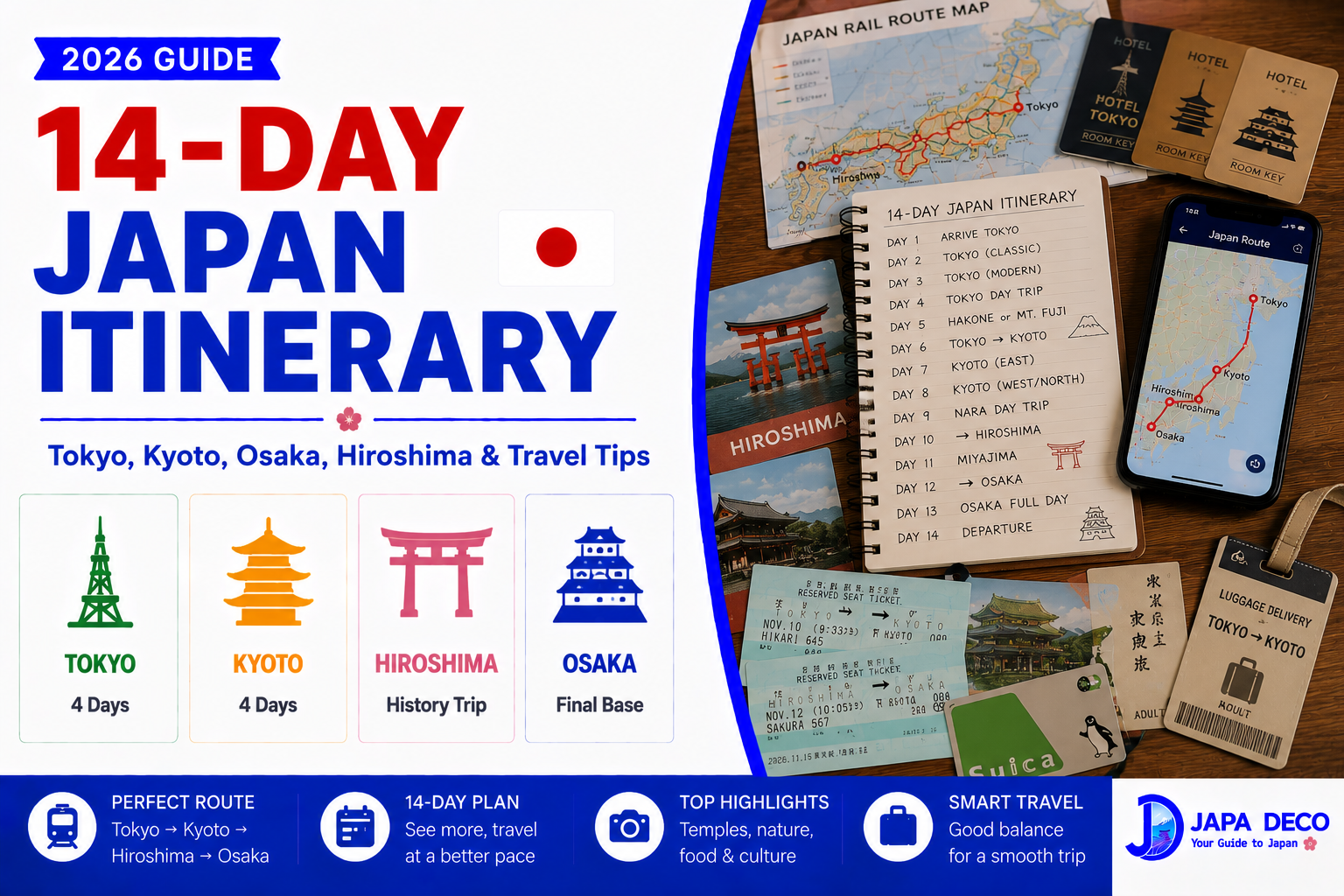
Should You Add Hiroshima?
Hiroshima and Miyajima are excellent, but adding them to a 10-day trip depends on your pace.
It can work if you reduce something else.
For example:
- Tokyo: 3 nights
- Kyoto: 3 nights
- Hiroshima: 1 night
- Osaka: 2 nights
This is a stronger route for travelers who want history and a wider Japan experience.
But for a first trip, Tokyo, Kyoto, Osaka, and Nara are already enough.
Do not add Hiroshima if it makes every day rushed.
Should You Add Mt. Fuji?
Mt. Fuji is possible in 10 days.
The easiest options are:
- Hakone overnight
- Kawaguchiko overnight
- Day trip from Tokyo if weather is good
However, Mt. Fuji visibility depends on weather.
Do not build your entire trip around one exact Fuji viewing day.
If you want a smoother first trip, use Day 4 as your possible Fuji or Hakone day and keep it flexible.
Luggage Strategy
Luggage can make or break a 10-day itinerary.
Useful options:
- Luggage delivery from Tokyo to Kyoto
- Coin lockers for day trips
- Hotel luggage storage
- Smaller suitcase
- Backpack for one-night trips
If you move from Tokyo to Kyoto, luggage delivery is very useful.
It lets you ride the Shinkansen and explore without carrying a large suitcase.
Common Mistakes to Avoid
The biggest mistake is adding too many cities.
Another mistake is changing hotels every one or two nights.
Some travelers also underestimate how tiring Kyoto can be because of walking, buses, slopes, and crowds.
Do not plan a long-distance train ride on departure day without a large buffer.
Do not make every meal a reservation.
Do not forget rest time.
A 10-day itinerary should feel full, not exhausting.
Best Recommendation for First-Time Visitors
For most first-time visitors, the best 10-day Japan itinerary is:
Tokyo for 4 nights.
Kyoto for 3 nights.
Osaka for 2 nights.
Then depart from Kansai Airport if possible.
This gives you a strong route with fewer risks.
You get Tokyo’s energy, Kyoto’s culture, Osaka’s food, and a day trip option such as Nara.
It is classic because it works.
Conclusion
A 10-day Japan itinerary is one of the best choices for first-time visitors.
It gives you more breathing room than a 7-day trip while still staying focused.
The best route is usually Tokyo, Kyoto, Osaka, with Nara, Hakone, Kamakura, or Mt. Fuji as optional additions.
The key is balance.
Do not add too many cities.
Stay near useful stations, use the Shinkansen wisely, plan travel days lightly, and leave space for weather, food, shopping, and rest.
With a smart route, 10 days in Japan can feel complete without feeling rushed.
コメント