Introduction
Seven days in Japan is enough for a great first trip, but only if you avoid doing too much.
Many first-time visitors try to visit Tokyo, Kyoto, Osaka, Hiroshima, Mt. Fuji, Nara, Hakone, and more in one week. On paper, it looks exciting. In reality, it can become tiring, expensive, and rushed.
For a 7-day Japan itinerary, the best plan is simple: choose fewer bases, reduce hotel changes, and focus on the places that give the strongest first-time experience.
This guide gives a practical 7-day Japan itinerary for first-time visitors, with Tokyo, Kyoto, and Osaka as the main route.
Quick Answer
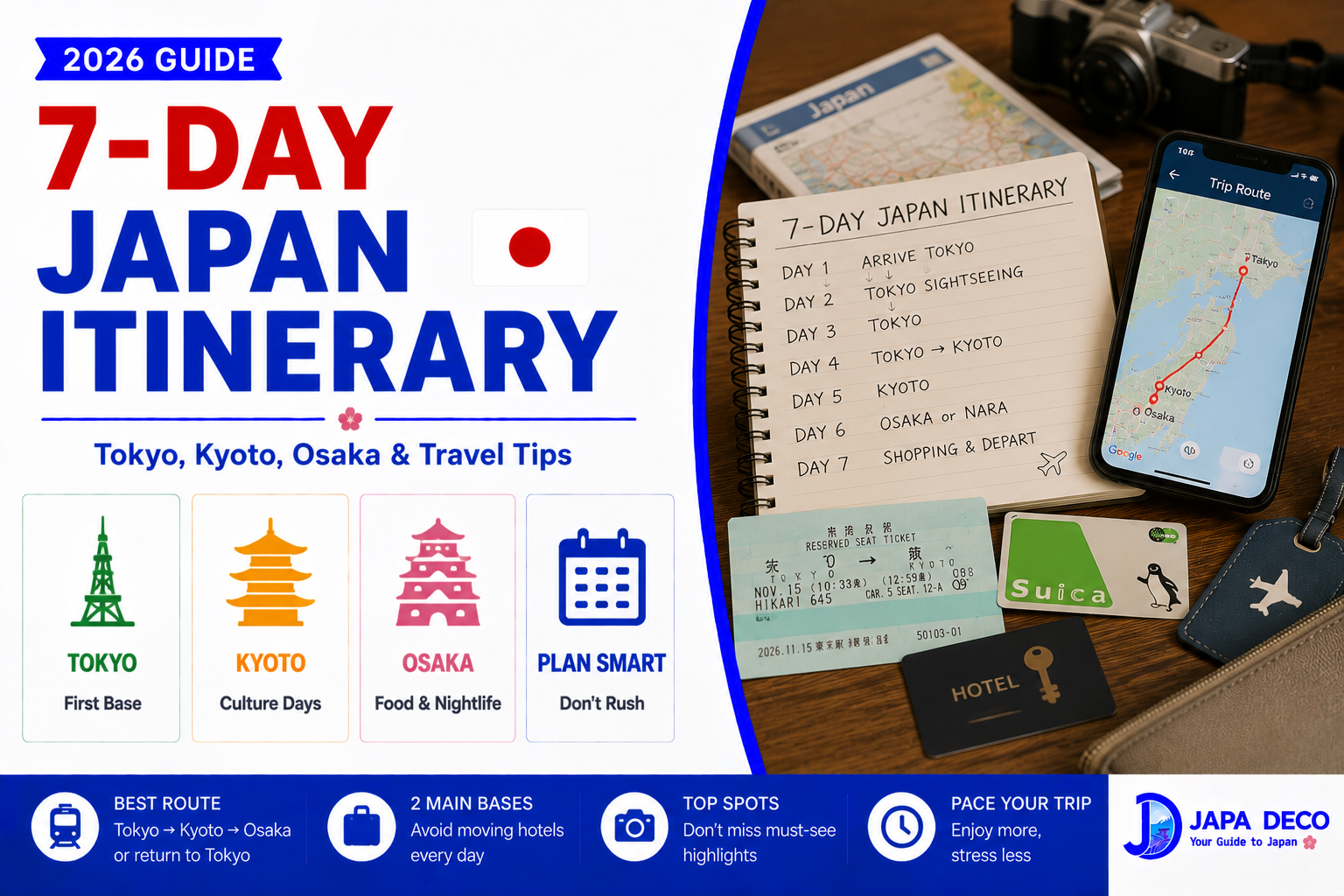
For most first-time visitors, a good 7-day Japan route is:
- Day 1: Arrive in Tokyo
- Day 2: Tokyo sightseeing
- Day 3: Tokyo sightseeing
- Day 4: Travel to Kyoto
- Day 5: Kyoto sightseeing
- Day 6: Osaka or Nara day trip
- Day 7: Final shopping and departure
This route is not too rushed, but still gives a strong first Japan experience.
If your flight arrives and leaves from Tokyo, stay mostly in Tokyo and Kyoto.
If your flight arrives in Tokyo and leaves from Osaka, the route becomes easier.
Best Route for 7 Days
The best first-time route is usually:
Tokyo → Kyoto → Osaka
or
Tokyo → Kyoto → Tokyo
The first route works well if you fly into Tokyo and out from Kansai Airport.
The second route works if your international flights are both from Tokyo.
Do not change hotels every night.
For seven days, two main bases are enough.
Three bases can work, but only if your flights and schedule are efficient.
Day 1: Arrive in Tokyo
Day 1 should be easy.
After a long flight, immigration, luggage, airport transfer, and hotel check-in can take time.
Good Day 1 ideas:
- Check into hotel
- Get IC card ready
- Buy snacks and drinks
- Walk around hotel area
- Eat simple dinner
- Sleep early
Do not plan a major attraction on arrival day.
If you arrive early and feel good, choose one light activity near your hotel.
Tokyo Station, Shinjuku, Ueno, Asakusa, or Shibuya can work depending on where you stay.
【Image①】
Day 2: Classic Tokyo
Day 2 is your first full day in Tokyo.
A balanced plan could be:
Morning:
- Asakusa
- Sensoji Temple
- Nakamise shopping street
Afternoon:
- Ueno
- Akihabara
- Tokyo Station area
Evening:
- Shibuya
- Shinjuku
- Tokyo night view
Do not try to visit every famous Tokyo area in one day.
Tokyo is huge.
Choose areas that connect naturally by train.
Day 3: Modern Tokyo or Local Tokyo
Day 3 can focus on a different side of Tokyo.
Option A: Modern Tokyo
- Harajuku
- Omotesando
- Shibuya
- Shinjuku
Option B: Relaxed Tokyo
- Meiji Shrine
- Yoyogi Park
- Daikanyama
- Nakameguro
- Local cafes
Option C: Family or theme park day
- Tokyo Disneyland
- Tokyo DisneySea
- TeamLab-style attraction
- Aquarium
- Shopping mall
Use Day 3 to match your travel style.
Tokyo is not only sightseeing. It is also food, shopping, neighborhoods, and atmosphere.
Day 4: Tokyo to Kyoto
Day 4 is your travel day.
Take the Shinkansen from Tokyo to Kyoto.
Do not overload this day.
A good plan:
Morning:
- Check out
- Send luggage if needed
- Take Shinkansen to Kyoto
Afternoon:
- Check into Kyoto hotel
- Visit Nishiki Market
- Walk around Gion or Kamogawa River
Evening:
- Simple Kyoto dinner
- Early rest
Kyoto is best enjoyed slowly.
Arriving and trying to visit three temples immediately is usually too much.
Day 5: Kyoto Sightseeing
Day 5 is your main Kyoto day.
A strong first-time Kyoto plan:
Morning:
- Fushimi Inari
- Early start recommended
Late morning or afternoon:
- Kiyomizu area
- Sannenzaka and Ninenzaka
- Yasaka Shrine
- Gion
Evening:
- Pontocho
- Kamogawa River
- Kyoto Station area
Kyoto becomes crowded, so start early.
Do not rely only on buses. Trains, walking, and taxis can sometimes save time.
【Image②】
Day 6: Osaka or Nara
Day 6 should be a day trip from Kyoto or Osaka.
Option A: Osaka
Good for food and nightlife.
Visit:
- Osaka Castle
- Dotonbori
- Namba
- Shinsekai
- Umeda
Option B: Nara
Good for temples, deer, and a calmer cultural day.
Visit:
- Nara Park
- Todaiji Temple
- Kasuga Taisha
- Local shopping street
Option C: Stay in Kyoto
Good if you prefer slower travel.
Visit:
- Arashiyama
- Kinkakuji
- Philosopher’s Path
- Smaller temples
For first-time visitors, Osaka is better if you want food and city energy.
Nara is better if you want history and nature.
Day 7: Final Day
Day 7 depends on your airport.
If leaving from Kansai Airport:
- Stay in Osaka or Kyoto the night before
- Do light shopping
- Go to airport early
If leaving from Tokyo:
- Return to Tokyo on Day 6 evening or Day 7 morning
- Do not risk a tight same-day Shinkansen connection before an international flight
Final day ideas:
- Buy souvenirs
- Eat a simple last meal
- Visit one nearby spot
- Check luggage
- Leave early for airport
Do not plan a major attraction far from the airport on departure day.
Should You Add Mt. Fuji?
Mt. Fuji is popular, but it can make a 7-day itinerary harder.
A Mt. Fuji or Hakone stop works best if:
- You accept a slower route
- You remove something else
- You stay overnight
- The weather is good
- You do not mind extra transport planning
A common mistake is trying to add Mt. Fuji as a quick extra stop between Tokyo and Kyoto.
It is possible, but not always smooth.
For a first 7-day trip, Tokyo and Kyoto are usually more reliable.
Should You Add Hiroshima?
Hiroshima is excellent, but it is better for a 10-day or 14-day trip.
In seven days, adding Hiroshima often makes the itinerary rushed.
If Hiroshima is very important to you, reduce something else.
For example:
- Tokyo 2 nights
- Kyoto 2 nights
- Hiroshima 1 night
- Osaka 1 night
This can work, but it is fast.
For most first-time visitors, save Hiroshima for a longer trip.
Where to Stay
Good hotel strategy:
Tokyo:
- Stay near a useful train station
- Shinjuku, Ueno, Tokyo Station, Ginza, Shibuya, Asakusa, or Ikebukuro can work
Kyoto:
- Stay near Kyoto Station, Shijo-Karasuma, Kawaramachi, or a useful train/subway area
Osaka:
- Namba or Umeda are convenient
For a 7-day trip, hotel location is very important.
Bad location wastes time every day.
【Image③】
Luggage Tips
Luggage can make short trips harder.
Use:
- Luggage delivery
- Coin lockers
- Hotel luggage storage
- Smaller suitcase
- Backpack for day trips
If moving from Tokyo to Kyoto, luggage delivery can make the Shinkansen day much easier.
You can travel with only a small day bag.
This is especially useful for families or travelers with large suitcases.
Food Strategy
Do not overbook restaurants every day.
A good food plan:
- Convenience store breakfast sometimes
- Casual lunch near sightseeing areas
- One or two special dinners
- Osaka for street food
- Kyoto for traditional atmosphere
- Tokyo for variety
Japan has excellent casual food.
You do not need expensive restaurants to eat well.
Leave room for spontaneous meals.
Common Mistakes to Avoid
The biggest mistake is adding too many cities.
Another mistake is changing hotels too often.
Some travelers plan famous attractions from morning to night with no rest.
Do not underestimate train transfers, walking, weather, and luggage.
Do not plan a long-distance train on departure day unless you have a large time buffer.
And do not treat a 7-day trip like a 14-day trip.
Best Recommendation for First-Time Visitors
For most first-time visitors, the best 7-day plan is:
Tokyo for city energy.
Kyoto for culture.
Osaka or Nara for a final day trip.
Keep the route simple.
Use good hotel locations.
Start Kyoto early.
Avoid too many long-distance moves.
This gives you a strong Japan experience without exhausting yourself.
Conclusion
A 7-day Japan itinerary works best when it is simple and focused.
Tokyo, Kyoto, and Osaka or Nara give a strong first-time experience without trying to see the whole country.
The key is to avoid rushing.
Stay in good locations, reduce hotel changes, plan travel days lightly, and leave room for food, walking, and unexpected discoveries.
Japan rewards slow attention.
In seven days, you cannot see everything, but you can still have an excellent first trip if you plan smart.
コメント