Introduction
Fourteen days in Japan gives you enough time to enjoy the country without rushing too much.
With two weeks, you can visit Tokyo, Kyoto, Osaka, Nara, Hiroshima, and one or two extra areas such as Hakone, Kanazawa, Miyajima, or Mt. Fuji. This length is much more comfortable than a 7-day trip and gives you more flexibility than a 10-day trip.
However, two weeks can still become stressful if you add too many cities.
The best 14-day Japan itinerary should balance famous highlights, travel time, food, rest, and backup days.
This guide gives a practical first-time Japan route for travelers who want a strong and realistic two-week plan.
Quick Answer
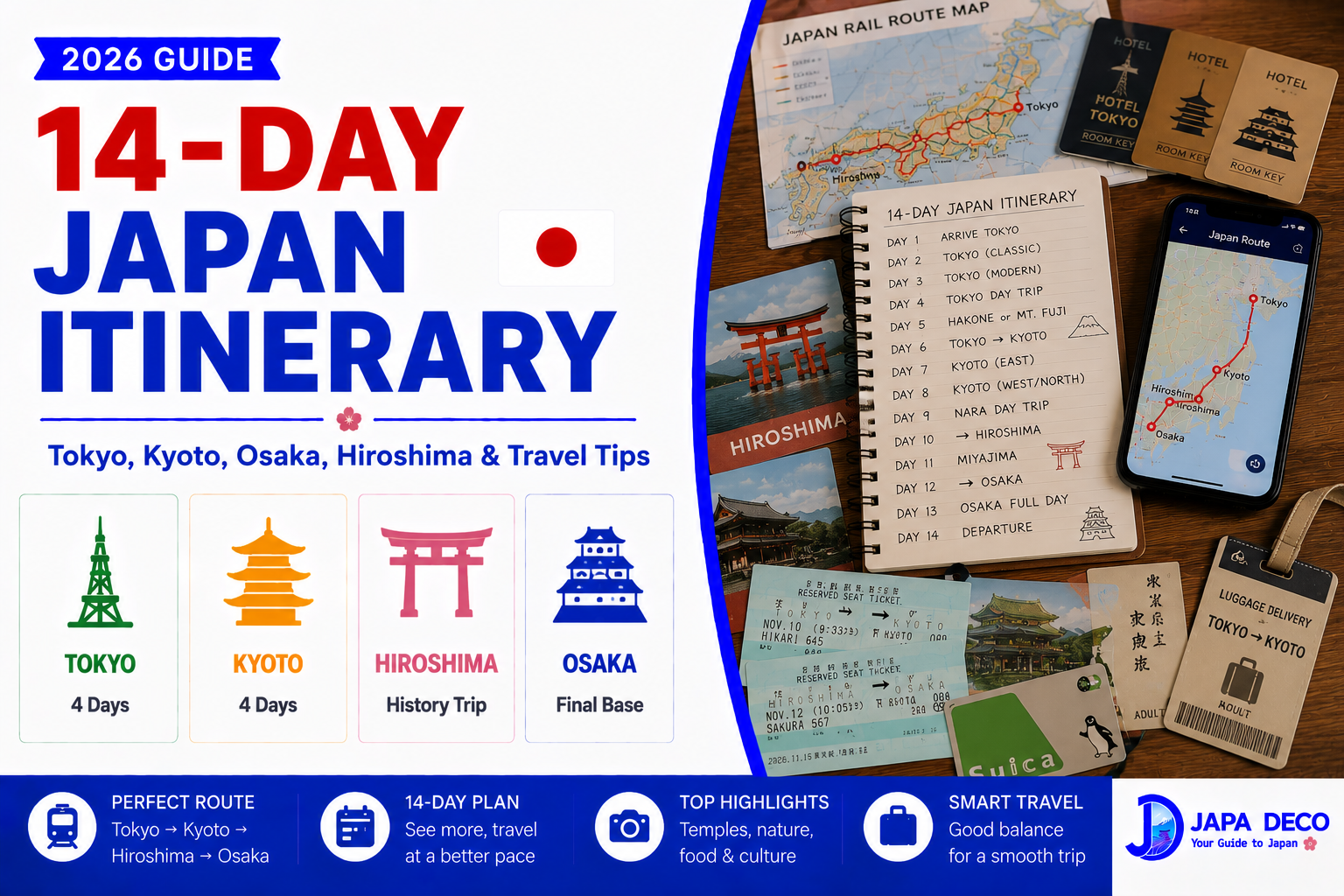
A strong 14-day Japan itinerary is:
- Day 1: Arrive in Tokyo
- Day 2: Tokyo classic sightseeing
- Day 3: Modern Tokyo
- Day 4: Tokyo local neighborhoods or day trip
- Day 5: Hakone or Mt. Fuji area
- Day 6: Travel to Kyoto
- Day 7: Kyoto east side
- Day 8: Kyoto west or north side
- Day 9: Nara day trip
- Day 10: Travel to Hiroshima
- Day 11: Hiroshima and Miyajima
- Day 12: Travel to Osaka
- Day 13: Osaka sightseeing and food
- Day 14: Departure
This route works best if you fly into Tokyo and out from Osaka.
If your flights are both from Tokyo, return to Tokyo before your final night.
Best Route for 14 Days
For most first-time visitors, the best route is:
Tokyo → Hakone or Fuji area → Kyoto → Nara → Hiroshima → Osaka
This route gives a good mix of:
- Big city
- Traditional culture
- Nature
- Food
- History
- Day trips
- Easy Shinkansen movement
You do not need to visit every famous place in Japan.
A good two-week trip should feel complete, not overloaded.
Day 1: Arrive in Tokyo
Day 1 should be simple.
After landing, immigration, luggage pickup, airport transfer, and hotel check-in can take time.
Good Day 1 ideas:
- Check into hotel
- Get IC card ready
- Buy water and snacks
- Walk near your hotel
- Eat a simple dinner
- Sleep early
Do not plan a major sightseeing day after an international flight.
If you arrive early, choose one nearby area only.
Day 2: Classic Tokyo
Day 2 is your first full Tokyo day.
A balanced route:
Morning:
- Asakusa
- Sensoji Temple
- Nakamise shopping street
Afternoon:
- Ueno
- Akihabara
- Tokyo Station or Ginza
Evening:
- Shibuya
- Shinjuku
- Tokyo night view
This gives you old Tokyo, shopping, food, trains, and modern city energy.
Do not try to see every famous Tokyo area in one day.
Tokyo is huge.
【Image①】
Day 3: Modern Tokyo
Day 3 can focus on modern Tokyo.
Good areas include:
- Harajuku
- Meiji Shrine
- Omotesando
- Shibuya
- Shinjuku
This day works well for shopping, cafes, fashion, city views, and famous streets.
If you like anime, games, or electronics, adjust the day toward Akihabara, Ikebukuro, or Nakano.
If you prefer quiet neighborhoods, choose Daikanyama, Nakameguro, Kichijoji, or Yanaka.
Tokyo is flexible, so match the day to your interests.
Day 4: Tokyo Day Trip or Extra Tokyo
Day 4 gives you room to breathe.
Good options:
- Kamakura
- Nikko
- Yokohama
- Extra Tokyo shopping
- Museum day
- Theme park day
- Local neighborhoods
Kamakura is good for temples and seaside atmosphere.
Nikko is beautiful but takes more effort.
Yokohama is easy and relaxed.
If you are tired, stay in Tokyo and keep the day light.
A two-week trip should include some slower moments.
Day 5: Hakone or Mt. Fuji Area
Day 5 is a good nature or onsen day.
Popular options:
- Hakone
- Kawaguchiko
- Fuji Five Lakes
- Onsen ryokan stay
- Mt. Fuji viewing area
Hakone is convenient between Tokyo and Kyoto.
Kawaguchiko can offer better Mt. Fuji views, but access needs more planning.
Weather matters.
Mt. Fuji visibility is not guaranteed.
If nature is not important to you, skip this stop and add another Tokyo or Kyoto night.
Day 6: Travel to Kyoto
Day 6 is your move to Kyoto.
Keep the day comfortable.
A good plan:
Morning:
- Check out
- Send luggage if needed
- Travel to Kyoto
Afternoon:
- Check into hotel
- Nishiki Market
- Kamogawa River
- Gion walk
Evening:
- Simple dinner
- Rest early
Kyoto is best when you are not exhausted.
Do not overload your first Kyoto day.
【Image②】
Day 7: Kyoto East Side
Day 7 is a classic Kyoto sightseeing day.
A good route:
Morning:
- Fushimi Inari
- Go early if possible
Late morning or afternoon:
- Kiyomizu area
- Sannenzaka and Ninenzaka
- Yasaka Shrine
- Gion
Evening:
- Pontocho
- Kamogawa River
- Kyoto Station area
Kyoto has many famous places, but crowds and walking can be tiring.
Choose quality over quantity.
Day 8: Kyoto West or North Side
Day 8 gives you another Kyoto area.
Option A: Arashiyama
- Bamboo Grove
- Togetsukyo Bridge
- Tenryuji
- Riverside walk
Option B: Northern Kyoto
- Kinkakuji
- Ryoanji
- Kitano area
Option C: Calm Kyoto
- Philosopher’s Path
- Nanzenji
- Eikando
- Local cafes
Do not try to do every Kyoto temple.
Kyoto becomes more enjoyable when you move slowly and leave time for small streets.
Day 9: Nara Day Trip
Nara is one of the easiest and best day trips from Kyoto or Osaka.
Good first-time route:
- Nara Park
- Todaiji Temple
- Kasuga Taisha
- Local shopping street
- Easy cafe or dinner
Nara is good because it combines temples, nature, deer, and a calmer pace.
It is also a nice break between Kyoto sightseeing and bigger city movement.
Return to Kyoto or move to Osaka depending on your hotel plan.
Day 10: Travel to Hiroshima
Day 10 is your Hiroshima travel day.
Take the Shinkansen from Kyoto or Osaka to Hiroshima.
A good plan:
Morning:
- Travel to Hiroshima
- Store luggage or check in
Afternoon:
- Peace Memorial Park
- Peace Memorial Museum
- Atomic Bomb Dome
Evening:
- Hiroshima-style okonomiyaki
- Relax near hotel
Hiroshima is important and meaningful.
Do not rush the Peace Memorial area.
Give it enough time and respect.
【Image③】
Day 11: Miyajima
Day 11 is ideal for Miyajima.
Good route:
- Travel to Miyajima
- Visit Itsukushima Shrine
- Walk near the waterfront
- Try local snacks
- Visit shops
- Consider Mt. Misen if you have time and energy
Miyajima can be one of the most memorable parts of a two-week Japan trip.
Check tide times if the floating torii view is important to you.
You can stay overnight on Miyajima or return to Hiroshima.
For most first-time visitors, returning to Hiroshima is easier.
Day 12: Travel to Osaka
Day 12 moves you to Osaka.
Keep it practical.
A good plan:
Morning:
- Travel from Hiroshima to Osaka
Afternoon:
- Check into hotel
- Namba
- Dotonbori
- Shopping streets
Evening:
- Osaka food night
- Takoyaki
- Okonomiyaki
- Casual izakaya
Osaka works well near the end of the trip because it is fun, food-focused, and close to Kansai Airport.
Day 13: Osaka Full Day
Day 13 is your main Osaka day.
Good options:
- Osaka Castle
- Umeda
- Namba
- Kuromon Market
- Shinsekai
- Dotonbori
- Shopping
- Food tour style walking
Osaka is less about checking temples and more about atmosphere.
Eat well, walk slowly, and enjoy the signs, shops, and streets.
If you prefer a theme park day, this can also be your Universal Studios Japan day.
Day 14: Departure
Day 14 depends on your airport.
If leaving from Kansai Airport:
- Stay in Osaka the night before
- Keep the day light
- Buy souvenirs
- Go to the airport early
If leaving from Tokyo:
- Return to Tokyo on Day 13
- Do not risk a tight same-day Shinkansen transfer
Departure day should be simple.
Do not plan major sightseeing far from the airport.
Should You Add Kanazawa?
Kanazawa is a strong option for a 14-day itinerary.
It is good for:
- Gardens
- Samurai districts
- Seafood
- Traditional streets
- Museums
- Slower travel
You can add Kanazawa by reducing Hiroshima, Hakone, or one Tokyo day.
A possible route:
Tokyo → Kanazawa → Kyoto → Osaka
This is good for travelers who want a less standard route.
Should You Add Hokkaido or Okinawa?
Hokkaido and Okinawa are excellent, but they add flight time and planning.
For a first 14-day Japan trip, they are optional.
Add Hokkaido if you want:
- Snow
- Nature
- Food
- Wide landscapes
Add Okinawa if you want:
- Beaches
- Islands
- Warmer weather
- Different culture
But do not add them just to say you went.
Japan is already full with the main route.
Luggage Strategy
For 14 days, luggage strategy matters.
Use:
- Luggage delivery
- Coin lockers
- Hotel storage
- Smaller suitcase
- Day backpack
- Packing cubes
- Laundry days
Send luggage from Tokyo to Kyoto if you stay overnight in Hakone.
Send luggage from Kyoto or Osaka if you do a short Hiroshima stay.
This makes the trip much easier.
Hotel Strategy
For two weeks, stay near useful stations.
Good bases:
Tokyo:
- Shinjuku
- Ueno
- Tokyo Station
- Ginza
- Shibuya
- Asakusa
- Ikebukuro
Kyoto:
- Kyoto Station
- Shijo-Karasuma
- Kawaramachi
Hiroshima:
- Near Hiroshima Station
- Near Peace Park
Osaka:
- Namba
- Umeda
Hotel location is more important than saving a small amount.
Bad location wastes time every day.
Common Mistakes to Avoid
The biggest mistake is adding too many cities.
Another mistake is changing hotels too often.
Some travelers plan no rest time, then feel exhausted by Day 8.
Do not underestimate walking.
Do not plan every meal as a reservation.
Do not move long-distance on departure day without a large buffer.
Do not carry large luggage everywhere when luggage delivery is available.
Best Recommendation for First-Time Visitors
For most first-time visitors, the best 14-day route is:
Tokyo for 4 nights.
Hakone or Fuji area for 1 night.
Kyoto for 4 nights.
Hiroshima for 2 nights.
Osaka for 2 nights.
This route gives a full Japan experience without becoming too chaotic.
You get cities, temples, nature, history, food, and day trips.
It is busy, but realistic.
Conclusion
A 14-day Japan itinerary gives you enough time to experience Japan properly.
You can enjoy Tokyo, Kyoto, Osaka, Nara, Hiroshima, Miyajima, and possibly Hakone or Mt. Fuji without rushing as much as shorter trips.
The key is balance.
Do not add too many places.
Use good hotel locations, plan travel days lightly, send luggage when useful, and leave space for rest, weather, food, and unexpected discoveries.
Two weeks in Japan can feel rich, smooth, and memorable if you travel with a clear route instead of trying to see everything.
コメント