Introduction
Japan can be cheaper or more expensive than travelers expect. It depends on how you travel.
You can eat well from convenience stores, ramen shops, supermarkets, and casual restaurants. Local trains can be affordable. Many parks, temples, shrines, shopping streets, and city walks are low-cost or free.
At the same time, hotels in popular areas, Shinkansen trips, theme parks, taxis, luggage services, and last-minute bookings can raise your budget quickly.
This guide explains how to think about a Japan travel budget, where money usually goes, and how first-time visitors can plan without overspending.
Quick Answer
For most travelers, the biggest Japan trip costs are:
- Flights
- Hotels
- Long-distance trains
- Food
- Local transport
- Attractions
- Shopping
- Internet
- Travel insurance
- Luggage services
Japan can work for budget, mid-range, and higher-end trips.
Japan-guide lists sample daily budgets ranging from low to high depending on travel style, with mid-range travel costing more when accommodation is included. JNTO also notes examples such as Tokyo subway day tickets, airport buses, and JR Pass prices in its budget travel guidance. (japan-guide.com) (japan.travel)
Main Budget Categories
A Japan travel budget is easier to understand when you split it into categories.
The main categories are:
- Accommodation
- Food
- Local transport
- Long-distance transport
- Attractions
- Shopping
- Internet
- Insurance
- Luggage
- Emergency money
Do not only calculate hotels and flights.
Daily small costs add up quickly.
Coffee, lockers, subway rides, vending machine drinks, snacks, temple fees, and train transfers can make your spending higher than expected.
Accommodation
Hotels are often the biggest daily cost after flights.
Prices depend on:
- City
- Season
- Location
- Room size
- Hotel type
- Booking timing
- Weekend or weekday
- Number of guests
Tokyo, Kyoto, Osaka, Hakone, theme park areas, and famous seasonal destinations can become expensive during busy periods.
Golden Week, cherry blossom season, autumn leaves, Christmas, New Year, and major events can raise prices.
For budget control, location matters.
A slightly more expensive hotel near a useful station can save time and transport stress.
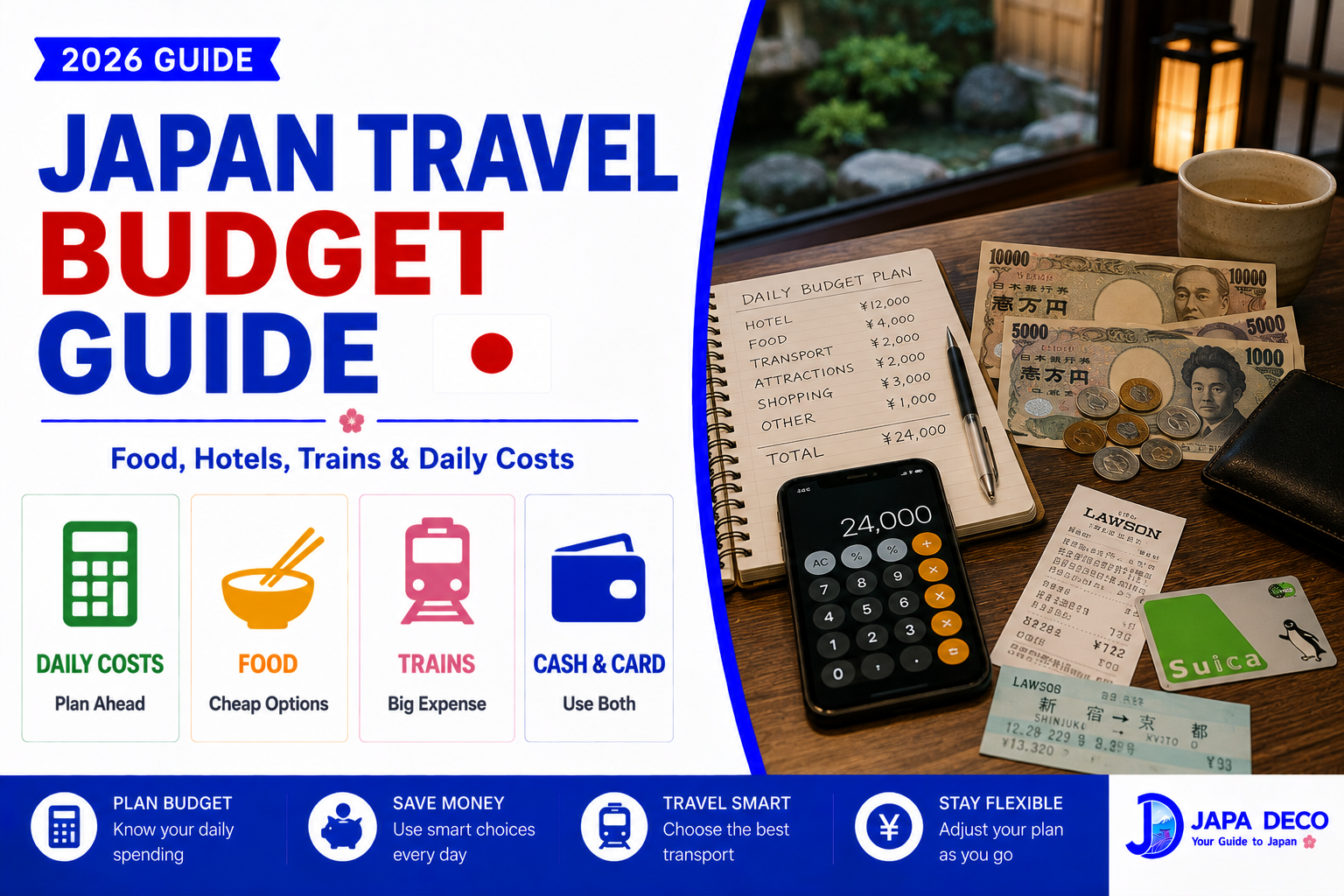
【Image①】
Food Costs
Food in Japan can be very flexible.
Cheap and practical options include:
- Convenience stores
- Supermarkets
- Ramen shops
- Gyudon chains
- Udon shops
- Curry restaurants
- Bento shops
- Bakery items
- Department store food floors near closing time
Mid-range options include casual restaurants, sushi chains, izakaya, cafes, and local dining.
High-end options include kaiseki, fine sushi, wagyu, hotel dining, and special-course restaurants.
You do not need expensive meals every day to enjoy Japan.
A strong budget strategy is to mix simple meals with a few special meals.
Convenience Stores and Supermarkets
Convenience stores are one of the best budget tools in Japan.
They are useful for:
- Breakfast
- Snacks
- Drinks
- Rice balls
- Sandwiches
- Bento
- Coffee
- Desserts
- Emergency meals
- ATMs
Supermarkets can be even better for dinner or snacks.
Many supermarkets discount prepared food in the evening.
This is useful if you want to save money without eating poorly.
Local Transport
Local trains, subways, and buses are usually manageable, but they still add up.
In big cities, you may take several rides per day.
Useful tools include:
- IC card
- Subway day passes
- Route apps
- Walking between nearby areas
- Staying near a good train line
JNTO’s budget guide gives examples of city transport options, including Tokyo Metro 24-hour tickets and other day passes. (japan.travel)
Do not buy a day pass automatically.
It only saves money if you ride enough times.
Shinkansen and Long-Distance Travel
Long-distance travel is one of the biggest costs in Japan.
Shinkansen is fast and convenient, but it is not cheap.
A route like Tokyo to Kyoto or Osaka can take a large part of your budget.
Before booking many cities, think carefully.
A common mistake is building an itinerary with too many long-distance moves.
More city changes mean more train costs, more luggage stress, and less time.
For budget travel, stay longer in fewer bases.
【Image②】
JR Pass and Regional Passes
The Japan Rail Pass can help some travelers, but it is not automatically worth it.
After price changes, many visitors need to calculate carefully.
JNTO lists the 7-day Japan Rail Pass ordinary price from 50,000 yen in its budget travel guide. (japan.travel)
A rail pass may work if you travel long-distance many times in a short period.
It may not work if you only do Tokyo, Kyoto, and Osaka.
Regional passes can sometimes be better than the national pass.
Always compare your actual route before buying.
Attractions and Entry Fees
Many Japan experiences are free or low-cost.
Free or low-cost activities include:
- Shrines
- Parks
- City walks
- Shopping streets
- Some temples
- Riversides
- Observation areas
- Local neighborhoods
- Food markets
- Seasonal scenery
Paid attractions include:
- Theme parks
- Museums
- Observation decks
- Gardens
- Castles
- Special exhibitions
- Guided tours
- Cultural experiences
A good budget plan mixes free walking areas with paid highlights.
Do not pay for every attraction just because it appears in a guidebook.
Shopping
Shopping is where budgets can quietly explode.
Common spending includes:
- Snacks
- Cosmetics
- Anime goods
- Clothes
- Souvenirs
- Stationery
- Kitchen goods
- Electronics
- Convenience store items
- Tax-free shopping
Set a shopping budget before your trip.
Japan has many tempting small purchases.
A 500 yen item here and a 1,000 yen item there can become a large amount by the end of the trip.
Tax-free shopping can help eligible visitors, but it is not a reason to buy things you do not need. Japan’s official tax-free shopping guidance explains that eligible visitors can buy certain goods without consumption tax when requirements are met. (mlit.go.jp)
Cash and Cards
Japan is more cashless than before, but cash is still useful.
Use cards for hotels, major shops, restaurants, and online bookings.
Use cash for:
- Small restaurants
- Shrines
- Temples
- Local shops
- Coin lockers
- Some buses
- Small festivals
- Rural areas
- Emergency backup
Japan’s standard consumption tax rate is 10%, with a reduced rate for some food and beverages. (nta.go.jp)
Keep some cash, but do not carry your whole trip budget in one wallet.
【Image③】
Internet, Insurance, and Small Costs
Small travel essentials also matter.
Budget for:
- eSIM or pocket WiFi
- Travel insurance
- Power adapter
- Luggage delivery
- Coin lockers
- Laundry
- Medicine
- Umbrella
- Drinks
- Snacks
- Replacement items
These are not exciting costs, but they make travel easier.
For example, luggage delivery can save stress even if it costs extra.
A good budget is not only about spending less. It is about spending where it improves the trip.
Budget Travel Strategy
For a lower-cost Japan trip:
- Stay in business hotels or simple hotels.
- Use convenience stores and casual restaurants.
- Avoid too many Shinkansen rides.
- Stay longer in one city.
- Use subway passes only when useful.
- Visit free parks, shrines, and neighborhoods.
- Travel outside peak seasons.
- Book early.
- Limit taxis.
- Set a shopping limit.
Budget travel in Japan is possible without feeling poor.
The key is to control hotels and long-distance transport.
Mid-Range Travel Strategy
For most first-time visitors, mid-range travel is the most comfortable.
A good mid-range plan includes:
- Convenient hotels near stations
- Casual restaurants plus a few special meals
- Reserved Shinkansen seats
- eSIM or pocket WiFi
- Some paid attractions
- Occasional taxi when useful
- Luggage delivery for difficult transfers
This style usually gives the best balance of comfort and cost.
You do not need luxury hotels to have a great Japan trip.
Common Mistakes to Avoid
The biggest mistake is underestimating transport costs.
Another mistake is booking too many cities.
Some travelers also choose hotels far from stations to save money, then lose time and energy every day.
Do not forget seasonal price changes.
Do not rely only on cards.
Do not spend heavily on small souvenirs without tracking.
And do not skip travel insurance only to save a small amount.
Best Recommendation for First-Time Visitors
For first-time visitors, plan your budget in this order:
- Flights
- Hotels
- Long-distance trains
- Food
- Attractions
- Local transport
- Internet and insurance
- Shopping
- Emergency money
This order works because flights, hotels, and Shinkansen are the big fixed costs.
After that, daily spending is easier to control.
Choose fewer bases, stay near stations, mix cheap meals with special meals, and keep cash as backup.
Conclusion
Japan can fit many budgets, but travelers need to understand where money goes.
Hotels, Shinkansen, and busy-season travel can raise costs quickly. Food, local transport, and sightseeing can be affordable if you choose carefully.
The best budget strategy is not simply spending as little as possible.
It is spending smart.
Stay near useful stations, avoid too many long-distance moves, book early, use convenience stores and casual restaurants, and save money for experiences that really matter to you.
With good planning, Japan can feel comfortable, practical, and worth the cost.
コメント