Introduction
A Japan trip becomes much easier when you prepare the basics before you fly.
Japan is safe and convenient, but first-time visitors can still run into small problems: no mobile data, wrong plug adapter, not enough cash, forgotten medicine documents, hotel check-in issues, or too much luggage.
A simple checklist helps you avoid stress.
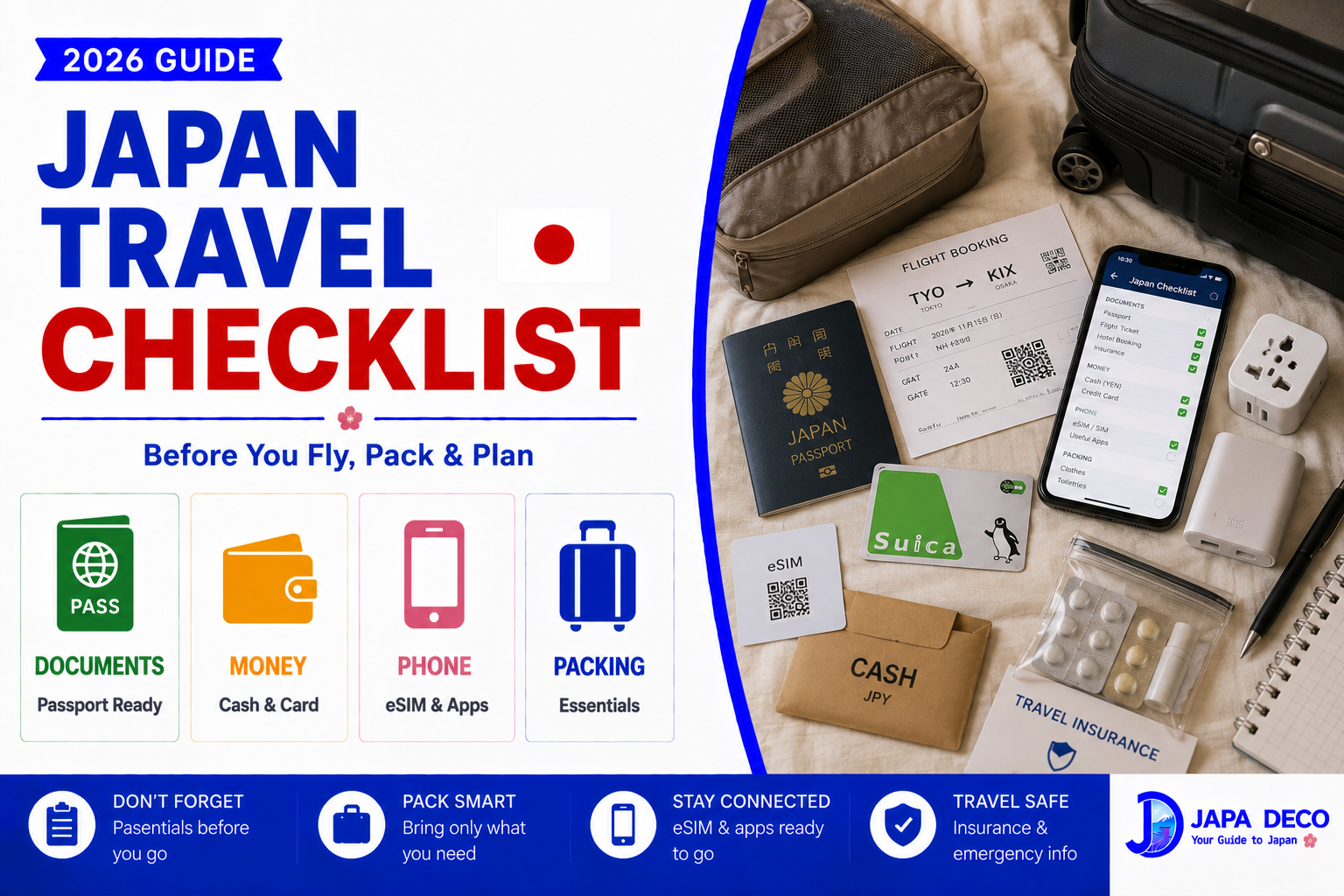
This guide gives a practical Japan travel checklist for documents, money, phone setup, packing, transport, hotels, health, and final pre-flight preparation.
Quick Answer
Before traveling to Japan, check:
- Passport
- Visa or entry rules if needed
- Flight booking
- Hotel bookings
- Travel insurance
- eSIM or pocket WiFi
- Credit card and cash
- IC card plan
- Power adapter
- Medication rules
- Weather and clothing
- Airport transfer
- Luggage plan
- Emergency contacts
- Offline copies of important information
Do not leave everything until the night before your flight.
Documents
Prepare your important documents first.
Check:
- Passport validity
- Visa rules if needed
- Flight confirmation
- Hotel booking confirmation
- Travel insurance policy
- Emergency contact details
- Passport copy
- Driver’s license if needed
- Medication documents if needed
Save digital copies on your phone.
Also keep important screenshots offline.
If your internet does not work after arrival, screenshots can still help.
Passport and Entry
Your passport is the most important item.
Before travel, check:
- Passport expiration date
- Name matches flight booking
- Blank pages if needed
- Visa or entry requirement
- Return or onward flight details
- Hotel address for arrival forms if required
Do not pack your passport deep inside checked luggage.
Keep it in your carry-on bag.
Also save a photo or scan of your passport separately.
【Image①】
Flights and Airport Transfer
Before your flight, confirm:
- Departure airport
- Arrival airport
- Terminal
- Flight time
- Baggage allowance
- Seat assignment
- Airline app
- Airport transfer route
- Last train or bus time
- Hotel check-in time
Japan has multiple major airports.
Tokyo can mean Haneda or Narita.
Osaka can mean Kansai Airport or Itami.
Do not assume the airport is close to the city center.
Hotels
Check your hotel details before arriving.
Prepare:
- Hotel name
- Full address
- Check-in time
- Late arrival rule
- Nearest station
- Exit number if available
- Booking confirmation
- Payment method
- Luggage storage rule
- Contact number
Japanese hotel rooms can be small, so packing lighter helps.
If arriving early, check whether the hotel can store luggage.
If arriving late, confirm late check-in rules.
Money
Japan is more cashless than before, but cash is still useful.
Prepare:
- Credit card
- Backup card
- Some Japanese yen
- ATM plan
- IC card or mobile IC setup
- Coin purse
- Emergency cash
- Card company travel notice if needed
Cash is useful for small restaurants, temples, shrines, coin lockers, rural areas, and emergencies.
Do not carry all your money in one place.
Phone and Internet
Mobile data is essential in Japan.
You will use your phone for:
- Maps
- Train routes
- Translation
- Hotel information
- Tickets
- Messages
- Weather
- Restaurant searches
- Emergency help
Before departure, decide:
- eSIM
- Physical SIM
- Pocket WiFi
- International roaming
Also install useful apps before your trip.
Do not wait until the airport Wi-Fi is crowded or unstable.
【Image②】
Useful Apps
Useful apps include:
- Map app
- Train route app
- Translation app
- Weather app
- Airline app
- Hotel booking app
- eSIM app
- Taxi app if needed
- Safety alert app
- Payment or IC card app if supported
Set them up before your flight.
Make sure you can log in.
If two-factor authentication needs your home phone number, prepare before leaving.
Packing Essentials
Basic packing items include:
- Comfortable shoes
- Weather-appropriate clothing
- Power adapter
- Charging cables
- Power bank
- Medicine
- Toiletries
- Small towel
- Foldable bag
- Coin purse
- Passport pouch
- Luggage tag
- Packing cubes
- Umbrella or rain jacket depending on season
Do not overpack.
You will walk, use trains, carry luggage through stations, and move through hotel rooms that may be smaller than expected.
Clothing and Weather
Check the weather for your actual travel dates and cities.
Japan weather changes by region and season.
Tokyo, Kyoto, Osaka, Hokkaido, Okinawa, and mountain areas can feel very different.
Prepare for:
- Rainy season
- Summer heat
- Winter cold
- Snow areas
- Spring temperature changes
- Autumn morning and evening chill
Comfortable shoes are more important than stylish shoes.
Japan travel usually means a lot of walking.
Medicine and Health
If you take medicine, check Japan’s medication rules before travel.
Prepare:
- Medicine in original packaging
- Prescription copy
- Doctor letter if needed
- Generic ingredient names
- Medication list
- Allergy information
- Travel insurance details
Do not assume every medicine allowed in your country is allowed in Japan.
For essential medicine, check early.
Also pack basic items such as pain relief, stomach medicine, bandages, and any personal health items you rely on.
【Image③】
Luggage Plan
Think about luggage before you arrive.
Check:
- Suitcase size
- Hotel room size
- Train luggage rules
- Airport transfer
- Coin locker use
- Luggage delivery
- Laundry plan
- Day bag
Large suitcases can be difficult in stations, buses, stairs, and small hotel rooms.
For city-to-city travel, luggage delivery can make the trip easier.
For short trips, packing lighter is usually better.
Transport Preparation
Before your trip, understand the basics:
- Airport to city route
- IC card use
- Local train routes
- Shinkansen tickets if needed
- Reserved seats if traveling during busy seasons
- Last train times
- Taxi backup plan
- Luggage movement
You do not need to memorize every train.
But you should know your first route from the airport to the hotel.
That first transfer is often the most stressful part.
Food and Daily Planning
Japan is easy for food, but planning helps.
Before arrival, check:
- Convenience stores near hotel
- Breakfast options
- Restaurant areas
- Food allergies
- Dietary restrictions
- Busy restaurant times
- Cash-only places
- Reservation needs
Do not overbook every meal.
Leave space for casual food, convenience store snacks, local restaurants, and spontaneous finds.
Emergency Preparation
Save emergency information before travel.
Prepare:
- Police: 110
- Fire and ambulance: 119
- Hotel address
- Embassy or consulate contact
- Travel insurance emergency number
- Passport copy
- Medication list
- Allergy information
- Emergency contact person
Keep this information offline.
If your phone battery dies, a small paper backup can help.
Final 48-Hour Checklist
Two days before travel, check:
- Passport
- Flight time
- Hotel booking
- Airport transfer
- eSIM or Wi-Fi
- Cards and cash
- Travel insurance
- Weather
- Medication
- Chargers
- Power adapter
- Luggage weight
- Important screenshots
- Home keys
- Work or home responsibilities
Do not leave packing and document checks until the final night.
Small mistakes become bigger when you are tired.
Common Mistakes to Avoid
The biggest mistake is forgetting phone data setup.
Another mistake is packing too much.
Some travelers also forget to check medication rules.
Do not rely only on credit cards.
Do not assume every hotel allows very late check-in.
Do not arrive without knowing your airport transfer route.
And do not keep all important documents in one bag.
Best Recommendation for First-Time Visitors
For first-time visitors, prepare in this order:
- Passport and entry rules
- Flights and hotels
- Travel insurance
- Internet
- Money
- Airport transfer
- Packing
- Medicine
- Apps
- Emergency information
This order works because it starts with the things that can cause the biggest problems.
Once these are ready, the rest of the trip becomes much easier.
Conclusion
A Japan travel checklist helps prevent small problems from becoming stressful.
Before you fly, prepare your passport, hotel details, travel insurance, phone data, money, medication, packing essentials, and emergency contacts.
Japan is convenient, but preparation still matters.
The goal is not to pack perfectly.
The goal is to arrive with the important things handled so you can enjoy trains, food, cities, temples, shopping, and daily travel without unnecessary stress.
A simple checklist can make your first Japan trip feel much smoother from the moment you land.
コメント