
Narita Airport to Tokyo Station: Best Train, Bus and Transfer Options
Compare the Narita Express, airport bus and Skyliner transfer to reach Tokyo Station with the right balance of simplicity, cost and luggage comfort.
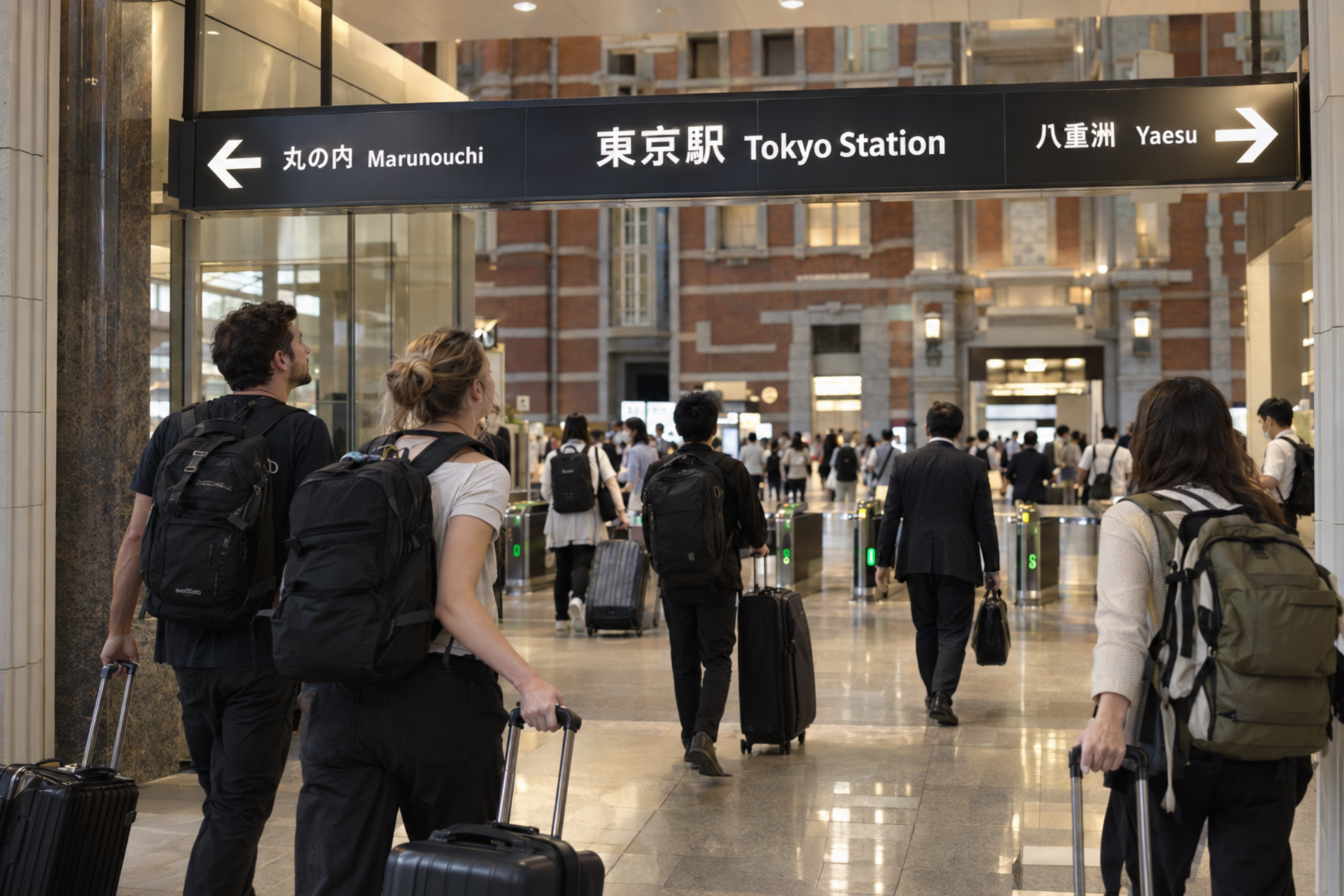
For most first-time visitors going specifically to Tokyo Station, the Narita Express is the simplest rail choice because it runs directly and provides dedicated luggage space. The Airport Bus TYO-NRT is usually the strongest lower-cost direct option if road traffic and the Tokyo-side stop suit your hotel. The Keisei Skyliner is fast to Nippori or Keisei-Ueno, but it does not serve Tokyo Station directly; reaching Tokyo Station normally requires a JR transfer at Nippori or another onward connection.
What You’ll Learn
- Which direct route is easiest after a long flight
- When the airport bus is more practical than the train
- Why the Skyliner requires a transfer for Tokyo Station
- How terminal, luggage and Tokyo Station exit choice affect the full journey
Choose by the complete arrival journey
Narita Airport is well outside central Tokyo, so the shortest advertised travel time is not the only number that matters. A route can look fast but become inconvenient after ticket purchase, a train change, a long station walk and the final trip to your hotel.
Start with the exact Narita terminal, the Tokyo Station side closest to your accommodation and the amount of luggage you can manage. Then compare the direct Narita Express, the direct airport bus and the Skyliner with its necessary Tokyo Station transfer.
- Simplest direct rail trip: Narita Express
- Direct and usually lower-cost road option: Airport Bus TYO-NRT
- Fast route to Nippori or Ueno with a transfer: Keisei Skyliner
- Door-to-door comfort for a group or difficult luggage: taxi or private transfer
Find the correct station at your Narita terminal
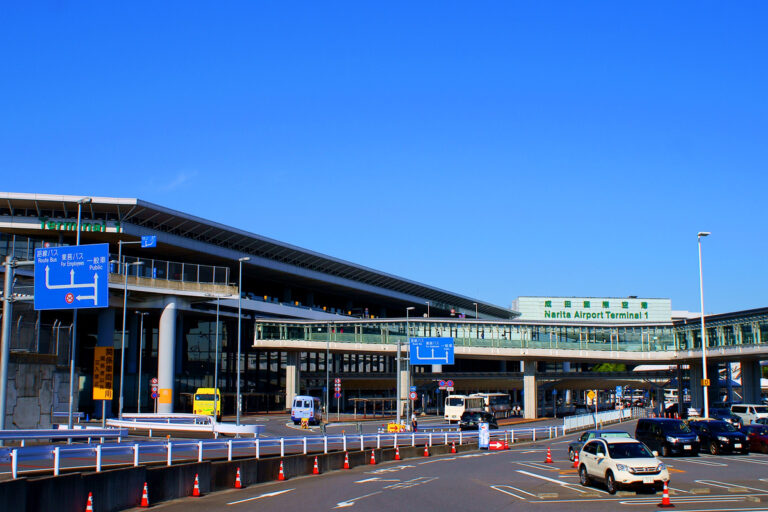
Terminal 1 uses Narita Airport Station. Terminals 2 and 3 use Narita Airport Terminal 2・3 Station, with Terminal 3 requiring a longer walk to the shared station area. Follow the railway signs only after confirming which terminal you landed at.
JR East and Keisei use separate ticketing and gates even though both railway areas are below the terminal. If you choose a bus, buy the correct departure ticket where required and confirm the terminal-specific platform shown on the current airport or operator information.
- Terminal 1: Narita Airport Station
- Terminal 2: Narita Airport Terminal 2・3 Station
- Terminal 3: walk to the Terminal 2・3 transport area
- Check the operator name before entering a railway gate
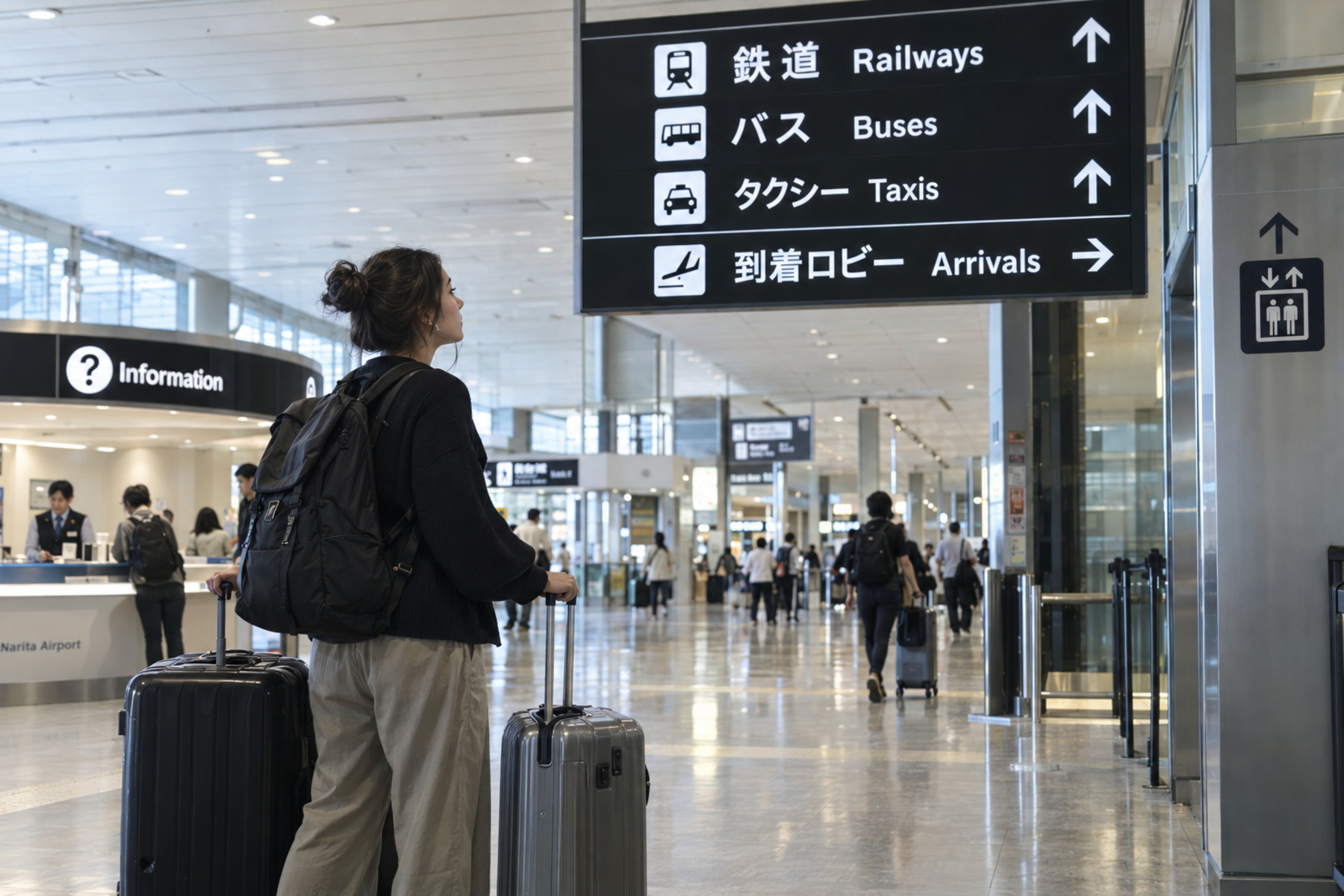
Narita Express: the easiest direct train
The JR East Narita Express, often shown as N’EX, directly links Narita Airport with Tokyo Station. It is particularly useful for first-time visitors, travelers continuing to a Shinkansen and anyone who prefers an assigned seat and fewer decisions after immigration.
The train provides dedicated luggage areas and onboard power outlets. A basic fare alone is not the complete N’EX ticket: you also need the applicable limited-express product. Buy the correct ticket or pass and reserve a seat through JR East's official system or airport sales facilities.
- Best for: direct rail travel to Tokyo Station
- Good for: medium or large luggage and onward JR connections
- Ticket point: confirm both the basic fare and limited-express requirement
- Arrival point: deep underground JR platforms at Tokyo Station
Airport Bus TYO-NRT: direct and luggage-friendly
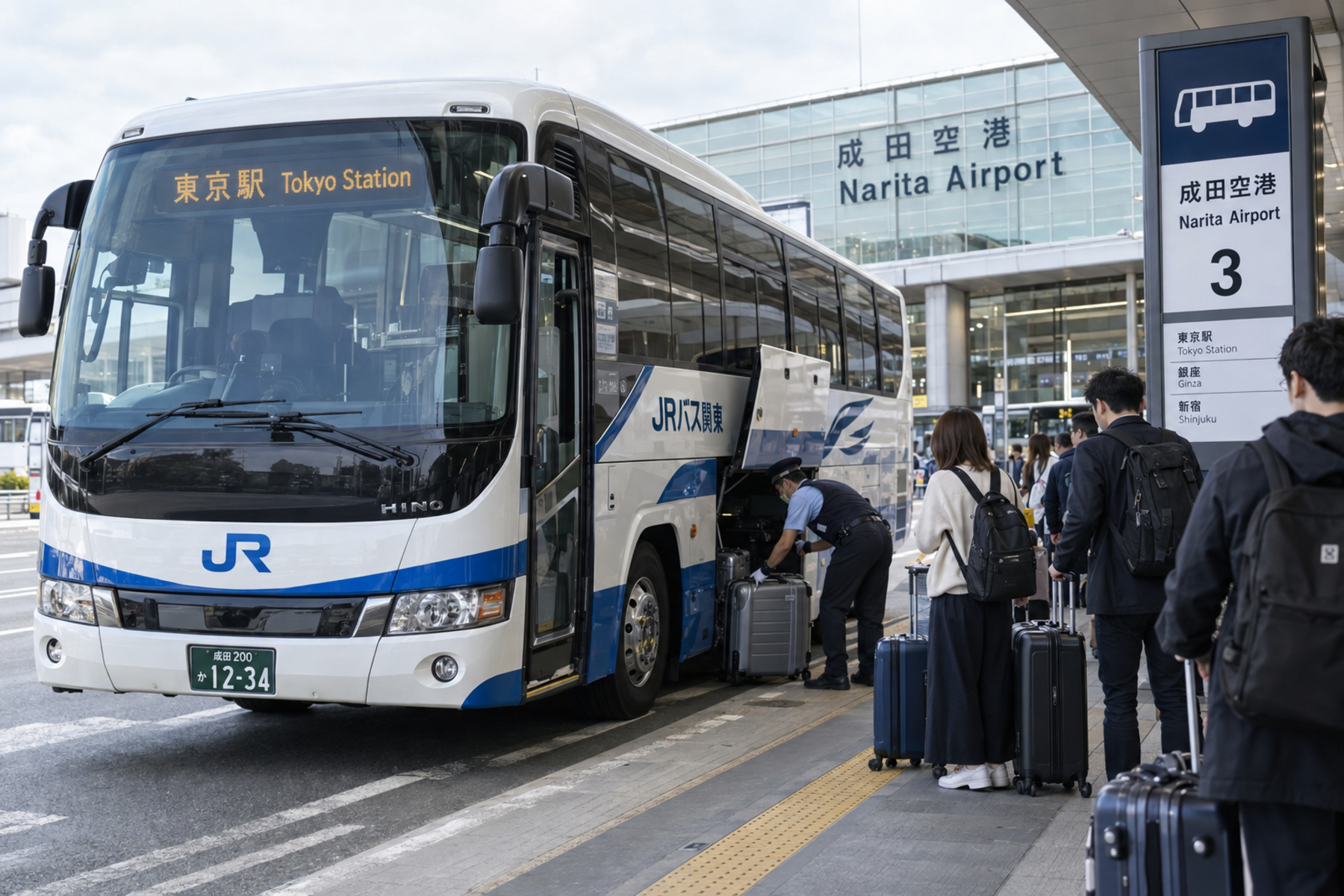
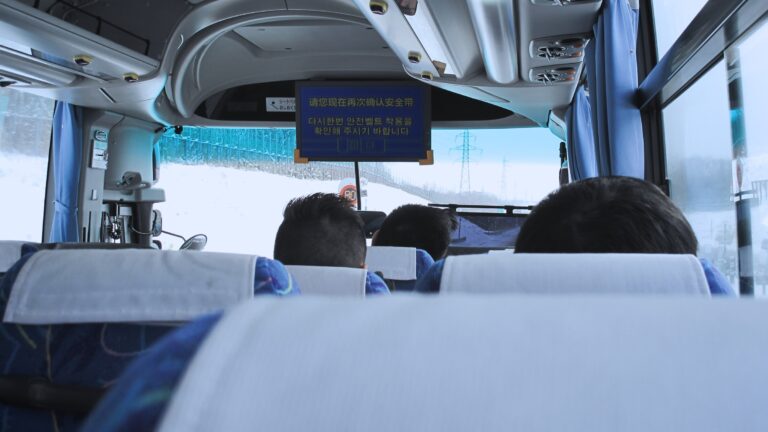
Airport Bus TYO-NRT runs directly between Narita Airport and Tokyo Station. Airport staff load larger suitcases into the lower luggage compartment, so the bus can be easier than navigating rail gates and escalators with multiple bags.
The trade-off is road traffic. A smooth journey can be straightforward, while congestion or an incident can extend it. At Narita, the operator instructs passengers to buy a ticket for a specific departure at the terminal counter, then arrive at the boarding point before departure. Confirm the current Tokyo Station stop because the bus does not arrive on the same side or level as the Narita Express.
- Best for: a direct ride with checked-size luggage
- Main advantage: no rail transfer or deep underground platform
- Main risk: variable road travel time
- Before boarding: verify the terminal platform and Tokyo Station stop
Keisei Skyliner: fast to Nippori, not direct to Tokyo Station
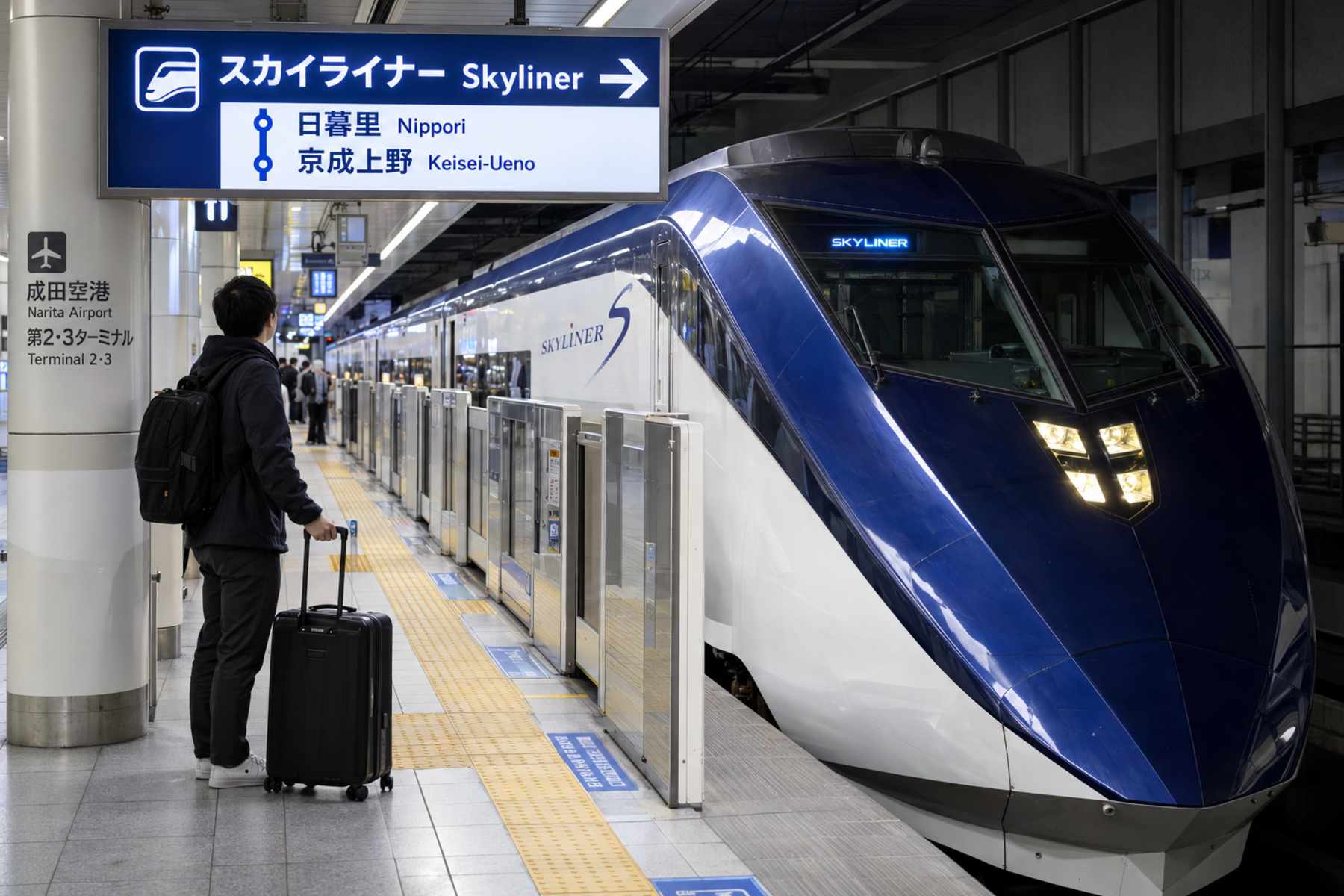
The Keisei Skyliner is a reserved-seat airport train with dedicated luggage space, but its central Tokyo terminals are Nippori and Keisei-Ueno. For Tokyo Station, the practical connection is usually to transfer from Keisei to JR at Nippori and continue on a JR line.
This route can make sense when the Skyliner departure fits immediately, when you are comfortable changing operators or when your real destination is closer to Nippori or Ueno than Tokyo Station. It is less attractive with several heavy suitcases because the transfer introduces another gate, platform and crowded local train.
- Best for: travelers comfortable with one operator change
- Transfer point: Nippori for onward JR travel to Tokyo Station
- Ticket point: the Skyliner seat and onward JR journey are separate considerations
- Do not assume: the Skyliner itself does not stop at Tokyo Station
Cheaper regular trains require more patience
Regular JR and Keisei services can reduce the ticket cost, but they make more stops and may require a transfer. They are designed as ordinary commuter services rather than a guaranteed airport-seat experience, so luggage space and seating are less predictable.
Choose a regular train only after checking the full route, not simply the first train listed at the airport. Confirm the operator, destination, stopping pattern and Tokyo-side transfer. A small saving may not be worthwhile after an overnight flight or during a busy commuter period.
- Good fit: light luggage and confidence using local trains
- Potential benefit: lower basic transport cost
- Potential drawback: more stops, transfers and crowding
- Check carefully: some services head toward other parts of Tokyo rather than Tokyo Station
Taxi and private transfer: comfort at a high price
A taxi or prearranged private transfer removes station transfers and takes you to the hotel entrance. This can be rational for a family, a group splitting the cost, travelers with mobility needs, unusually large luggage or an arrival after practical public transport options have ended.
Narita is far from central Tokyo, so this is normally the most expensive option. Confirm the total pricing method, vehicle capacity, meeting point and delay policy before booking. Do not assume a standard taxi can safely hold every passenger and suitcase in a large group.
- Best for: groups, accessibility needs and difficult luggage
- Main advantage: terminal-to-door travel
- Before booking: confirm vehicle and luggage capacity
- Main drawback: significantly higher cost than shared transport
Match the route to your luggage and group
One wheeled suitcase per person is manageable on the Narita Express because the train has dedicated storage. The airport bus is often easier when you want staff to load large bags and avoid the long underground walk from the N’EX platforms at Tokyo Station.
The Skyliner-to-JR transfer becomes less comfortable as luggage increases. For a family with children, count hands as well as bags: if one adult must manage two suitcases and a child, the direct bus or a booked vehicle may be the safer complete journey even if the rail segment is faster.
- N’EX: direct train with dedicated luggage areas
- Airport bus: large bags stored below the passenger cabin
- Skyliner plus JR: one additional transfer with luggage
- Private vehicle: confirm capacity rather than guessing from passenger count
Buying tickets and using an IC card
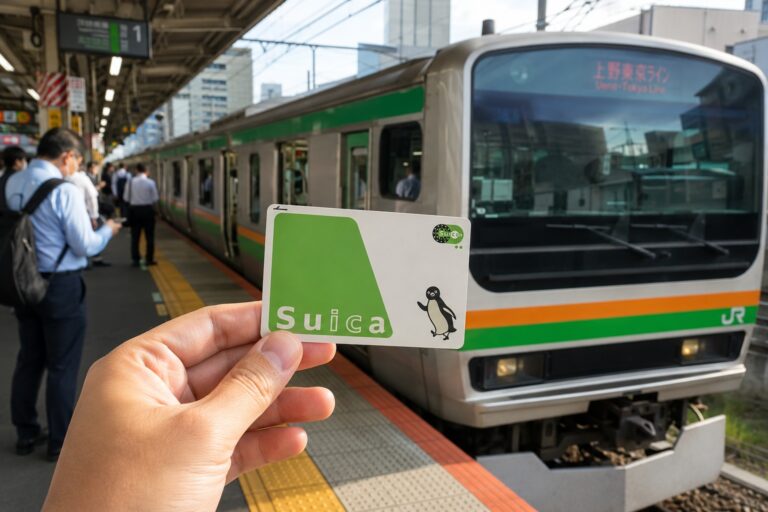
The Narita Express and Skyliner are limited or reserved-seat services, so an IC card by itself does not replace the required express or seat product. Follow the operator's ticket instructions and keep every ticket or digital credential available until the journey is complete.
For the JR connection after a Skyliner trip, Keisei's Nippori transfer guidance explains how to pass the transfer gate with the appropriate JR ticket or a sufficiently funded IC card. For the airport bus, payment and reservation rules differ by direction and departure, so check the current official boarding flow rather than applying train assumptions.
- N’EX: obtain the applicable limited-express ticket or valid pass
- Skyliner: obtain the reserved-seat airport train ticket
- Nippori transfer: prepare the onward JR fare or funded IC card
- Bus: follow the current airport-side ticket and boarding instructions
Navigating Tokyo Station after arrival
Narita Express platforms are deep below Tokyo Station. Follow signs for your final goal before climbing to street level: Marunouchi is generally the west side, while Yaesu and Nihombashi are on the east side. Reaching the wrong side can add a long indoor or outdoor walk.
Airport buses use surface stops around the Tokyo Station area, so check the exact stop map against your hotel entrance. For a Shinkansen connection, allow enough time to move through the station, identify the correct regional Shinkansen gates and handle any separate ticketing.
- Marunouchi: west side of Tokyo Station
- Yaesu and Nihombashi: east side of Tokyo Station
- N’EX arrival: allow time to come up from underground
- Bus arrival: verify the surface stop before walking to the hotel
Late arrivals, delays and missed departures
Immigration, baggage collection and customs can take longer than expected. Do not book an airport departure that leaves no recovery time after your flight's scheduled arrival. Check the final usable train or bus while you still have access to staffed airport counters.
If a flight delay causes you to miss a reserved N’EX or Skyliner service, ask the operator or use the official booking channel before boarding another departure. Ticket treatment depends on the product. If public transport is ending, compare a licensed taxi, a prearranged transfer and an airport-area hotel rather than rushing into an uncertain connection.
- Check live departures after clearing customs
- Allow recovery time before a separate Shinkansen booking
- Confirm ticket changes with the issuing operator
- Keep the airport-area hotel option in mind for a very late arrival
The practical decision rule
Choose the Narita Express for the simplest direct train to Tokyo Station. Choose Airport Bus TYO-NRT when a surface arrival, luggage handling and lower cost matter more than traffic certainty. Choose the Skyliner when its departure and the Nippori transfer suit you, or when Tokyo Station is not actually your final destination.
Before paying, verify the live timetable, ticket conditions, your Narita terminal and the Tokyo Station exit closest to the hotel. The best option is the one that remains easy from the arrivals hall to the accommodation door.
FAQ
What is the easiest way from Narita Airport to Tokyo Station?
The Narita Express is usually the easiest rail option because it serves Tokyo Station directly and has dedicated luggage space. The airport bus can be easier if you prefer a surface arrival and luggage loaded under the coach.
Does the Keisei Skyliner go directly to Tokyo Station?
No. The Skyliner serves Nippori and Keisei-Ueno. To reach Tokyo Station, travelers commonly transfer to JR at Nippori and continue on a local JR service.
Is the train or bus better with large luggage?
Both the Narita Express and airport bus handle luggage well. N’EX has dedicated onboard storage, while bus staff normally place larger suitcases in the lower compartment. The bus avoids the deep underground walk at Tokyo Station but can be delayed by traffic.
Can I use only an IC card on the Narita Express?
No. An IC card can cover the basic fare arrangement, but the Narita Express also requires the applicable limited-express ticket or a valid pass. Confirm the complete ticket before boarding.
Can I use an IC card for the Skyliner transfer at Nippori?
A funded IC card can be used for the onward JR portion through the appropriate Nippori transfer gate, but the Skyliner itself still requires its reserved-seat ticket. Follow Keisei's transfer-gate instructions for the ticket combination you hold.
Which Tokyo Station side is best for my hotel?
Marunouchi is on the west side; Yaesu and Nihombashi are on the east side. Check the hotel's exact entrance and the airport bus stop or N’EX walking route before choosing an exit.
What should I do if my flight arrives late?
Check live train and bus departures after customs, not just the scheduled landing time. If practical public transport has ended, compare a licensed taxi, a prearranged transfer and an airport-area hotel.
How much connection time should I allow for a Shinkansen at Tokyo Station?
Allow generous time for immigration and baggage at Narita, the airport journey, the deep N’EX platforms and navigation inside Tokyo Station. Avoid a tightly timed separate booking because flight and road delays are unpredictable.
Prefer a direct transfer to Tokyo Station?
For late arrivals, groups, families or heavy luggage, compare a private airport transfer with the rail and bus options above before booking.
Check Airport Taxi optionsRelated Japan Travel Guides


Official References
Final Thoughts
For Tokyo Station itself, the Narita Express is the cleanest direct rail answer, the airport bus is the practical direct road alternative and the Skyliner is a fast but transfer-dependent option. Match the route to your terminal, bags and station-side destination, then confirm the live operator information before paying.